Search

Showing posts with label film review. Show all posts

Tuesday, August 16, 2016

"I'll See You Again in 25 Years."

In the wake of Showtime's announcement of a long awaited/unexpected Twin Peaks third season, my curiosity compelled me to dig out my old print article of Fire Walk With Me as film reviewer for my university paper after a recent re-watch of both the show & film:

[Think the press kit got the caption wrong, since Michael J Anderson was The Man from Another Place.] 


Re-examining this vintage evaluation at the prophesied time later, I didn't give enough credit to Sheryl Lee, who had to travel soooo far down the emotional rabbit hole to get what she needed to play Laura Palmer's final descent into the Black Lodge. (And that Pink Room music still stands as the best Twin Peaks soundtrack cut!) Otherwise, I still agree with all the above, and feel that the David Lynch's strangely unique & nightmarish vision still haunts us ... and will always haunt us.

#     #     #

While a mostly happy bookstore fixture for over two decades, Guillermo Maytorena IV is currently willing to entertain your serious proposals for employment as a literary/cinema critic, goth journalist, castellan, airship pilot/crewperson, investigative mythologist, or assisting in a craft brewery. Should you be connected to any of the above or equally interesting endeavours, do contact him via LinkedIn or G+.


Friday, November 8, 2013

a second marvel-ous norse saga.

Co-opted from Norse lore by writer Stan Lee & artist Jack Kirby in 1962, their comic book Thor was designed as an adversary for The Hulk, but in selecting such a richly backgrounded character their story's potential far outgrew a mere contest-of-strength rivalry with the moody green simpleton in purple stretch pants. And here we are, hundreds of issues and half a century later, treated to the doom-filled thunder of Marvel's second pantheon-based cinematic blockbuster "Thor: The Dark World".

With the withdrawal of Shakespearian first director Kenneth Branagh due to Disney's less-generous shooting timetable, the sequel's helmed by Alan Taylor (episodes of "Game of Thrones"/"Mad Men"/"The Sopranos"), but the main difference being instead of having hammerless Thor humbled among the down home people of enchanting small town New Mexico, we find ourselves on a eye-goggling tour of the multiverse with the fate of not just frost giant populated Jotunheim to consider, but all the Nine Worlds at stake from a long-thought dead re-awakened ancient enemy.

Best performance in the film goes to ... Iceland! Iceland's starkness & desolate beauty easily depicts another world (most recently done in "Prometheus"). From a Thor-centric standpoint, it's appropo to use the nation with the most Thor prefixed place names, and who therefore historically honoured Thor the most. Volcanic rock, ashen landscape, outcroppings sculpted from tectonic violence, dancing aurora borealis, and midnight sun, all work to distance the viewer from the idea of a soundstage or digital environment with Iceland's abundantly exotic amazingness.

Best cameo goes to ... London! (Sorry, loveable Stan Lee.) It's great to see Marvel leave Manhattan as its metropolis of choice and upscale to some well-known London location placement. St. Paul's Cathedral, The London Eye, Greenwich Naval College, Thames River, Charing Cross Station, The Gherkin, and more. Having heroes & villains duke it out to damage some of those precious sites gave "T:TDW" a risk & flinch factor that hits literature's most beloved home, and that's also effectively played for laughs without breaking the tension.

The multiversal itinerary continues with glimpses of some of the other Nine Worlds: a beginning action sequence in Vanaheim, a flashback to Svartalfheim, a later stop through Jotunheim, and alot more of the home of the gods, Asgard, the Realm Eternal. And it's all these settings that lend the film a grandeur & scope worthy of Jack Kirby's world-building legacy.


[Jane Foster, you big Midgardian tourist!]

With any smart sequel the good things are carried forward: knit-bundled intern Darcy Lewis' perfectly timed quips (oh-so-hawt Kat Dennings), awkwardly cute astrophysicist Jane Foster (originally a nurse), the gratuitous Chris Hemsworth beefcake moment, parascientific explications of mythology, trickster Loki trickin', oh-no-we-shouldn't-do-it Asgardian decisionmaking, Idris Elba (BBC's "Luther") as stalwart Heimdall, Odin's sweet massive golden throne Hlidskjalf, all reappear to give us the touchstones we've waited two years to see again.

The first film was rooted in a father-son-son story, because having your dad running the universe as ruler of the gods while you bide your time over millennia for his job is bound to make heirs competitive, but after the first flush of obvious anger is spent, the complexity borrowed from the original Eddaic characters comes into play in this second chapter. The story continues to explore fallout from the Thor/Loki brotherly dynamic explosion in "The Avengers" (an overly bombastic offering which should be edited down to the Thor/Loki bits [and the shawarma eating easter egg because who ever really bought such a poorly mismatched group as The Avengers getting stuck together]), and expands upon an idea that resembles "The Animatrix" (2003) short "Beyond".

Other changes include the role of dashing Fandral being recast from Josh Dallas to Zachary Levi due to Dallas' obligations to "Once Upon a Time", energy & modern-style projectile weapons getting put up against the Asgardians' melee ones, an odd underused cameo from character actress Alice Krige (The Borg Queen from "ST: First Contact") as healing goddess Eir, and also underused Tony Curran (Marcus Corvinus of "Underworld: Evolution") as Odin's father Bor.

By contrast Rene Russo as Frigga gets a much longer turn as more than a foil for Anthony Hopkins' Odin and delivers a divine performance.

"T:TDW" presents some of the most striking design work, most notably an illuminated book whose designs animate on the pages themselves (with "The Secret of Kells" style but cooler since it's on a live action prop, or bearing resemblance to the limited but potent storytelling technique in a Marvel motion comic, such as "Thor & Loki: Blood Brothers" [which is in itself a really, really awesome Loki setpiece story]).


[Or like The Diamond Age's "A Young Lady's Illustrated Primer"!]
And there's the floating Jelling knotwork chandeliers which rotate & glow in Asgard that were totally golden, beautiful, and made you wish you could decorate with them.

Hearkening back to some 1960s film intros & outros, there were gorgeously painted end credits, meant to remind us that all of this visual richness originally came from a tradition of 1960s illustration.

Best of all "T:TDW" continues to fill in Marvel's mythological blanks in the Asgardian storyline, while still leaving some open for a definite trilogy in the making. Hail to the Hammer for "Thor 3"!


#  #  #

While a mostly happy bookstore fixture for over two decades, Guillermo Maytorena IV is currently willing to entertain your serious proposals for employment as a literary/cinema critic, goth journalist, castellan, airship pilot/crewperson, investigative mythologist, or assisting in a craft brewery. Should you be connected to any of the above or equally interesting endeavours, do contact him via LinkedIn or G+

Friday, December 17, 2010

the Legacy of Tron.

The success of 1982's "Tron" was because it rode the crest of arcade culture. If you were a kid pumping quarters into those arcade machines back in the day, you ate, drank, and sweated pixels because underneath it all you felt as though something more important was being accomplished on the other side of the screen. It was split-second life-or-death reaction times, and the payoff was when Flynn ends up on the other side of the cathode glass, and you find out it's all horrifically true: That we as users are electronic caesars committing our progamme gladiators to fight it out and kill for us, again and again and again.

Given how well that ethos of translation played out, you'd expect this 3.0 (because 2.0 already happened in a PC & console release awhile ago), that the game grid and digital environs would now reflect the ideas of time-consuming MMORPGs, first-person shooters, real-time strategy sims, higher-speed internet communications, terragig storage, smartphone applications, sexting, and all the other bells and whistles such technology has gifted us with in the last 28 years since the original "Tron". Instead what we have are updated designs on much of the things in the first film, plus a few new vehicles that should fly off toy shelves in time for the holidays. (Yes, I bought a die-cast Light Runner.)

Perhaps the true Legacy here is this: The investment of $200 million into this sequel only supports the fact that the 1980s still and will always rule the cultural school.


[Excellent double feature art poster credit to Eric Tan.]
Best bit? The Score. Pounding threat, electronics laced with a nearly human jarvik heartbeat so you know something's at risk. While Daft Punk's never been past a fun and rarified novelty, if they don't win an Oscar for this soundtrack, there's no justice on the aural grid.

The strength of Tron is its setting with all that it implies. The moment of emotional reaction of user being trapped in a computer world, that emotionally neutral wonderland of cold blues and angry reds being the dominant factor. Contrast with the compounding of Sam Flynn's reactions, and pushed over the edge by Michael Sheen's over the top performance as Castor, and what was once the placid cyberworld is now upstaged and imbalanced. The only apologetic I can fathom would be that since programs are now more sophisticated their behavior would be more emotional to reflect that, but the film doesn't imply this, and I had to come up with it.

Olivia Wilde is the digital hotness, and on top of that every lady in tightly glowing striped pajamas in this film is. Notably, icy blonde Beau Garrett's the digital coolness as Gem.

Nit picks: Jeff Bridges young computer generated face looked like digital botox -- it just never looked organically believeable. The light cycle sequence didn't have the uncontrollably insane velocity that was so felt in the first movie. Yes, it had alot of clever dynamic changes, but if it'd been rendered differently it might have possessed the hammering-heart-pushed-up-into-your-now-choking-neck thrill it should have.

And for a movie encapsulating the currents of lightspeed electrons, pacing flagged in a few spots. In the first even when there were moments you were learning something about the digital frontier, and it was more the still hum of a machine that you knew could wake up at any second. Here in parts where the chase isn't on, it's more like the machine's i7 got swapped for a P1 and you're waiting for the flippy hourglass to turn back into a cursor so you can get on with it.
Visually everything's very, very pretty. Spatially well defined, imparting a sense of place one'd love to visit and is left wanting more of at the end of two hours.

As a sequel "Tron Legacy" doesn't stand alone, but it makes a worthy successor to one of Disney's most ambitious modern classics. Helmets off to the house of mouse. Now let's go play some deadly frisbee on the Wii!

# # #

Post-Review Film-Influenced Addenda:

from 12.3.14:
Exciting Tron-esque teaser panel from "Batman Incorporated" issue #7 (July 2011).

Followed by Batgirl on lightcycle in issue #8 (August 2011).
Morrison & Clark may have partially wanted to homage 1990's "Batman: Digital Justice" (and "Dick Tracy" from the dialogue and catchphrase in that first panel [clever!]), the first completely computer illustrated graphic novel, but the lines of light, neon primaries, and the lightcycle are pure "Tron Legacy", and speaks alot for Tron programming our expectations of what a virtual reality version of the internet might look like as Bruce Wayne upsells it to potential investors.

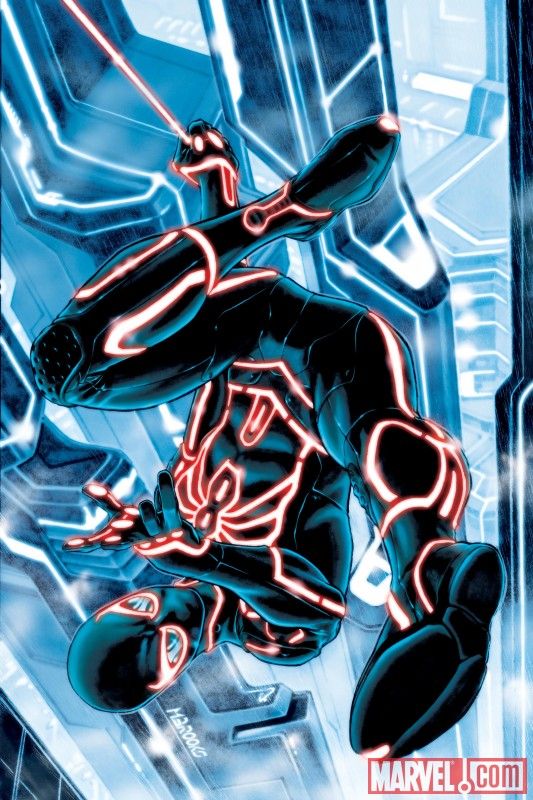
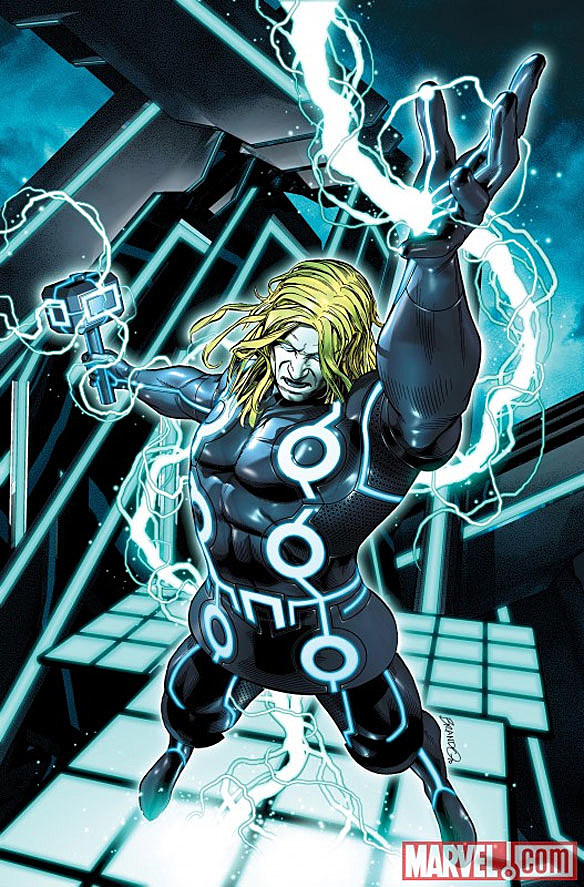
A month before the film, Marvel did a few "Tron Legacy" style variant covers as promotion for Disney, its parent company:
[Thor.]

[Spider-Man. Note Tron City-scape.]

From 9.12.13:

And then they got in ... to the real world:


[Happy accident lightcycle race in foreground. Photo credit goes to yours truly.]
It seems "Tron Legacy" director & professor of architecture Joseph Kosinski's design sensibilities & lightline styling accents have influenced someone else, and actually crossed through an I/O tower to rez up as Tucson's aLoft Hotel at Speedway & Campbell. At night it really does look like a data construct from The Grid.

from 8.3.13 at 4:07am:

Then there's nights when one re-screens with your peeps:Yes, Stacia & I derezz programs for the MCP!
[February 2011.]
Below, note the bottles of blue & green energy for thirsty video warriors, bowls of red vs blue computer chips, and, um, data-salsa. Yeah, hot mexi-data-salsa.
[Melisszler Vs Gwyeniflynn. July 2013.
Due to Grid wavelengths being outside of the visual 3700-7000 angstrom range, this photo's blurry. Also, Sark Lives! {somewhere in this shot}]


#    #    # 


While a mostly happy bookstore fixture for over two decades, Guillermo Maytorena IV is currently willing to entertain your serious proposals for employment as a literary/cinema critic, goth journalist, castellan, airship pilot/crewperson, investigative mythologist, or assisting in a craft brewery. Should you be connected to any of the above or equally interesting endeavours, do contact him via LinkedIn or G+.

Wednesday, September 9, 2009

Underworld is the Star Wars of vampire movies.

"Underworld" surpasses the idea of the creature feature. It personalizes the horror the way Anne Rice did, additionally throwing it back out into a greater context of conflicts. It's not just "Dracula vs the Wolf-Man", an indefatigable will slugging it out against uncontrollable beast -- it's an implication that these forces secretly dictate the workings of man. Michael Corvin's journey is the discovery of the darkness that underlies the mundane. And despite his every noble intention to practice medicine and save lives, the dark is in his blood and it's in our blood. This uneasy truth is what makes the film important & significant.

As primary example the first film gives its viewers Selene, a vampire warrior, a monster you root for and identify with. "Hunt them down and kill them off, one by one," Selene states as her joy. "I lived for it." Selene's accepted her darkness, using its inherent strength for a centuries long crusade of vengeance, and the virtue of that darkness attracts Michael. Corvin could instead turn his interest to the girl he helped save from the subway shootout, but the obsidian shadow he detects in himself, and in the nature of the world, appeals to him more.

While this edgy theme's the most insightful reason a studio-backed small budget film of $27 million unexpectedly garnered so much commercial success that it was re-issued in a sexy slipcased double DVD Unrated Extended Cut, there was quite alot more to it than that.

There's the litigation framing the picture to consider: White Wolf, makers of a roleplaying game wherein vampires & werewolves also happen to be bitter enemies, sues media giant Sony Pictures -- a losing battle. What the RPGers in Stone Mountain, Georgia, later forgot as the money kept rolling in over 13 prolific years was that they too built upon the mythic edifices which came before them: Augustine Calmet, Montague Summers, Bram Stoker, Richard Matheson, Whitley Streiber, Marv Wolfman, and of course Anne Rice. Director Len Wiseman denies he & his co-writers had any familiarity with the game, which is a legally safe answer (as legally safe as White Wolf stating their gaming books had no bearing on the vampiric murders committed by Roderick Ferrell in 1996). But even if writers Wiseman, Kevin Grevioux & Danny McBride had read the RPG sourcebooks, they took the archetypes and made them their own, exactly as all their predecessors had done, which is why there's a common set of similarities. The major divergence is the scientific: that both vampirism & lycanthropy spread from a mutagenic virus that only a small percentage of victims are susceptible to, cleverly accounting for why the mortal population hasn't been converted in epidemic proportions, and also why the urban decay endemic to the setting's ever present.

Plus, there's all the offscreen drama within the drama. Kate Beckinsale, respected for her roles in historical films, works against type by signing on to "Underworld" along with her longtime live-in boyfriend & father of her child Michael Sheen, who plays Lucian. While acting together might seem designed to ensure domestic tranquillity, during filming Kate and director Len Wiseman connect, and the British tabloids have a field day with the triangle as Kate relocates to LA to begin a new life with her new man. All this tension must have been channeled into the performances. When Lucian chases Selene's car, catches up to it, and punctures the roof with his sword to bury it in her shoulder, perhaps we're not just seeing a werewolf attack a vampire -- maybe we're witnessing a former lover stab his ex-girlfriend with relish as well.

A few months ago while waking up to one neighbor's brood cavorting on their back porch, my first reaction while lying in bed was to wish all the brats a painful loss of feet & tongues. "Hiss! Hiss!" a boy said. Then, "I'm a vampire!" And the girl also suddenly empowered said, "Now I'm a vampire too!" It made me want to go to Lown's and get all of them a pair of those cheap plastic fangs (but then I reconsidered as it might change their fearful impressions of me as the Goth next door). This mass influence, context & insight is why the 2003 "Underworld"'s achieved such cult status, meriting its hard-hitting 2006 sequel and this 2009's third medieval installment. Like the vampire, they will endure the test of time.
[Amelia, look out!]

#    #    # 


While a mostly happy bookstore fixture for over two decades, Guillermo Maytorena IV is currently willing to entertain your serious proposals for employment as a literary/cinema critic, goth journalist, castellan, airship pilot/crewperson, investigative mythologist, or assisting in a craft brewery. Should you be connected to any of the above or equally interesting endeavours, do contact him via LinkedIn or G+.

Friday, December 30, 2005

Into the Velvet Darkness: Vincent Price & The Masque of the Red Death.

During the mid-1960s aspiring director Roger Corman was wrangled by producers into making a series of films loosely based on the works of Edgar Allan Poe, most starring Vincent Price. Unforeseen by anyone, it would be this unlikely congruence of resourceful auteur, gothic progenitor, and incomparable leading man which resulted in the dark miracle that is "The Masque of the Red Death".

Set in early renaissance Europe, a plague known as The Red Death makes everyone it touches bleed from every pore of their body -- an excruciating end to the lives of millions. Yet safely within the sealed keep of tyrannical nobleman Prince Prospero (Vincent Price) an endless party of sinful delight and decadence goes on. Three peasants are also trapped with them whom Prospero plans to use as both fodder for his court's entertainment and object lessons to spread his satanic gospel.

As inhuman as Price's Prospero seems, he's also potently charismatic, and slowly convinces and compromises peasant girl Francesca (Jane Asher), whose life and faith (and the lives of her fiancee and father in the dungeon below) hangs in the balance, towards her first tentative steps to a darker illumination. At the same time his courtship of the naive Francesca destabilizes his relationship with fetching princess and disciple Juliana (Hazel Court), making for poisonously royal intrigue.


[It almost looks like they've been caught doing something ... .]
While much of this plot is not in the original 30-page short story, Corman integrates Poe's "Hop-Toad" too, and adds fitting elements to flesh out a top-notch hour and a half. And a viewer would never know Corman worked on a less than shoestring budget, with only five weeks to deliver it. Early Universal monster films aside, there are few other horror offerings more classic than this parade of costumed revelers, garishly gorgeous path color splash, and soul-stirring dialogue.

So put on your best Venetian mask and listen as Prince Prospero mellifluously intones, "The way is not easy, I know, but I will take you by the hand and lead you through the cruel light into the velvet darkness." Thank you for the soirée, sweet prince.
[Francesca listens to Prospero!]

#    #    # 


While a mostly happy bookstore fixture for over two decades, Guillermo Maytorena IV is currently willing to entertain your serious proposals for employment as a literary/cinema critic, goth journalist, castellan, airship pilot/crewperson, investigative mythologist, or assisting in a craft brewery. Should you be connected to any of the above or equally interesting endeavours, do contact him via LinkedIn or G+.
Wednesday, December 14, 2005

Your Future Looks Like a Danish Luxury Hotel: Aeon Flux's Sexy Dystopia.

The future will look like a very large Danish luxury hotel. At least if "Aeon Flux" has anything to say about it.

Set 400 years from now, a disease has decimated the world's population to a mere five million, all enclosed in the walled city-state of Bregna run by an iron-handed committee, opposed by righteous alt-looking Monican rebels who feel not all is right with the way things are. Disappearances and strange dreams for starters.

The attraction of the 1995 cartoon, aside from the obvious machine pistol toting lanky domina in catsuits with ram's horn tendrils, is the dichotomy of order versus change set within a mysterious Moebius-esque world. Totalitarian Chairman Trevor Goodchild and anarchist-assassin Aeon Flux are more than just characters -- they're concepts that give the other context. They need each other. And in that need there's a palpable lust that electrifies the story of their working at crosspurposes. They recognize they require each other to mean something, and that internal conflict of individual desire against a greater duty (whether it's to the state or the revolution) always made the outcome uncertain. Translating all these qualities to live-action movie, however, only works in some ways and not others, but the basic spirit is captured.

The severe design of the sets, some shot in Berlin with its Bauhaus concreteness, is gorgeous. By contrast, bad props, such as very plastic explosive charges, stick out like sore thumbs, along with fake computer generated elements. Costumes are all wonderful. Charlize Theron's black numbers are all winning. It's a shame that her performance doesn't hold up under equal scrutiny. Oh, it's mostly good like Marton Csokas' Goodchild, or Jonny Lee Miller ("Plunkett & Macleane"), but for all the principals there's moments where the emotional integrity just isn't being delivered, and those moments fail to skate by on looks alone.


Direction's from an MTV school -- understandable since it's an MTV property. But like many action films using tight shots and quick cuts, we lose a sense of space and fight choreography, and the far too trebley foleys do not help matters. Only when director Karyn Kusama selects long shots in some sequences, which is about half the time, a graceful ballet of violence is revealed.

And the movie explains much about the enigmatic cartoon -- why Aeon actually wears such a high-maintenance hairstyle, the rebels' rational for trying to destroy their perfect society, some practical uses behind Aeon's BSDM couture, and why the law of eternal return occurs. This last one was the most confusing for fans, but as the cartoon progressed it became accepted. The film underestimates general audiences by not using that device. If it had, it could have made one of its big revelations with so much more impact. (Yes, I'm being oblique here, but I'm trying very hard not to spoil things for you.)

Cinema can add "Aeon Flux"'s Bregna to its depiction of far future dystopias, like those of "Metropolis", "Dark City", "Logan's Run", and in extremis "1984" & "THX-1138". It's not the best of these predecessors, but it places as the sexiest.

#    #    # 


While a mostly happy bookstore fixture for over two decades, Guillermo Maytorena IV is currently willing to entertain your serious proposals for employment as a literary/cinema critic, goth journalist, castellan, airship pilot/crewperson, investigative mythologist, or assisting in a craft brewery. Should you be connected to any of the above or equally interesting endeavours, do contact him via LinkedIn or G+.