Search

Showing posts with label storytelling. Show all posts

Friday, March 17, 2017

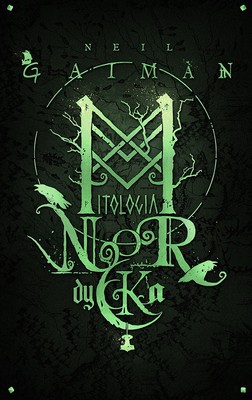
NorsePlay: Neil Gaiman's "Norse Mythology".

Neil Gaiman faced the daunting task to adapt the narrative holy of the holies, the ur-book stories, the most ancient tales known to man from which all other tales have since flowed from: Norse Mythology.

As we told a childhood friend of Neil's last month, Neil is a fearless writer, that before Neil there wasn't a great movement in the fantasy genre to use the Gods as actual intimate first & close third-person protagonists.


[Neil Gaiman being fearless!]
We look back at his record for this daring talent with reading pleasure: The Sandman (his breakout World Fantasy Award-winning graphic novel series expanding the being of Greek deity Morpheus), American Gods (heavily featuring Gods from various pantheons), and Odd & the Frost Giants (a NorsePlay story for children of all ages). And now, in a tribute to pay back what originally inspired him, Gaiman offers us his version of Norse Mythology.

In his introduction, Neil points out and mourns the loss of many stories in the Norse Lore, with only hints of more left behind in epithets and kennings:


I wish I could retell the tales of Eir, because she was the doctor of the gods, of Lofn, the comforter, who was a Norse goddess of marriages, or of Sjofn, a goddess of love. Not to mention Vor, goddess of wisdom. I can imagine stories, but I cannot tell their tales. (p.14)

You big tease, Mr. Gaiman, as we're pretty sure you could draft some. (And go check out "The Almighty Johnsons" for an interesting take on these goddesses.)


One can't help but hear Gaiman's comfortable English accent while reading. (If you're unfamiliar, listen to this.) Some authors make a total hash of reading their own work (talking to you, departed Douglas Adams), but the words here just rise off the page as though you're listening by a campfire. 


The bar for comparison will always be D'Aulaires' Norse Gods & Giants, but Gaiman instead grew up with Roger Lancelyn Green's Myths of the Norsemen. This early inspiration aside, he sources Snorri Sturluson, the Poetic Edda, and Rudolf Simek's Dictionary of Norse Mythology for his current retelling.


[Fenrir-fraught German edition cover.]
There's an open-endedness to the Norse Lore which allows the teller to detail in the blanks as they see fit. Everyone takes the opportunity to do so, and in this Gaiman is no different. Just when you thought you'd heard all the names for the Gods, he comes up with some original epithets, which is a skaldic achievement.

Charming anachronisms, born of Gaiman's penchant for contemporary urban fantasy (i.e. Neverwhere), make their way into his version of the Eddaic material. For instance, the giant that survives Ymir's flood of lifeblood does so by "clamoring onto a wooden box" (p.32), and smithy dwarf Brokk threatens Loki with converting his head into "A thinking machine (...) Or an inkwell." (p.55) The fact that these modern day items can flow backward and find a place inside these stories only reinforces the Norse Lore's timeless essence.


Other interesting additions and modifications in Gaiman's version include: the cosmic giant Ymir being made neither sex yet hermaphrodite, the detail of runes inscribed on the sides of Utgardaloki's bottomless challenge horn, the rationalization of Odin, Vili, & Ve wanting to create better worlds to live in & thus sanctioning the necessary sacrifice of Ymir to provide realm-building materials to do so, the prick of "Baldur's bell-like laughter...", a new character of Thyrm's conniving sister at Thor's marriage, and Mjölnir winning the the dwarven crafting contest because of its ability to protect, as Gaiman emphasizes that value far above the other entries.


Gaiman also specifically assigns the Vanir's Frey & Freya with the creation of Kvasir, which dovetails nicely into their role as both generative/creative gods and as the members of the post-war tribal exchange.


As the book continues, one can't help but notice Gaiman's enjoyment of writing Loki as a foil for events, especially seen in his extended embellishment of Loki's seduction of the giant's draft horse into something rather sensual.


"The Mead of Poets" is a brilliant standout. The dwarves who kill Kvasir are recast from spiteful miscreants into alchemists, which makes more sense for the murder's resultant beverage. And Bolverkr's underhanded wooing of Gunnlod's done as well as any modern lothario running game on a girl on any given club night.

"Hymir and Thor's Fishing Expedition" partly gets retold as a bad stepfather story, as Tyr's giantess mother marries the abusive & inhospitable Hymir, and we get a taste of Tyr's oppressive early home life.


Hel's half-dead side is descibed as looking into the "pale eye of a corpse" (the exact phrase Gaiman re-uses later for midwinter's brief and distant sun). Gaiman's previous empathetic personification of Death in Sandman may have been partly influenced by her Gothic-forbearer Hel:

"I am only myself, Hel, daughter of Angerboda and of Loki," she said. "And I like the dead best of all. They are simple things, and they talk to me with respect. The living look at me with revulsion."
One can't help but admire Hel's forthright manner, and despite the horror of her condition, she wins us with her self-acceptance, and also wins Odin when he gives her a fitting place in his cosmic scheme of things.

Gaiman reorders events to make more narrative sense. Odin raises the long dead wise woman völva only once, far later in the stories after Balder experiences his plague of nightmares. Gaiman also takes the liberty of making the völva Loki's lover & monster mother jötunness Angrboda, which makes her belligerent & doom-filled revelations to Odin more motivated. This shuffling of prophecy toward the end of things gives the reader a feeling that Ragnarök's too late to stop by the time Odin hears of it, which eliminates the usual planning versus destiny questions of why can't it be avoided if the Gods know about it from so early on in the stories' throughline.


[Hungarian edition.]
Like in Sandman, and in his introduction, Gaiman falls prey to the common slanderous reduction of Thor to a box of hammers ... which ignores Thor's verbally deft outwitting of dwaven Alvíss (actually meaning "All-Wise") to save his daughter Thrud from his amorous attentions, and Gaiman omits this story in his collection. 

A huge deviation in "The Story of Gerd and Frey" is that Gerd's refusal of Frey's proposal is completely skipped. One wonders if the coercion aspect was found to be distasteful by the author, but that's negated anyhow for most modern audiences by her finding mutual happiness with Frey at the end. He is a God of love after all, and being selected by love itself for marriage would be the ultimate compliment.

A serious missed-opportunity occurs in "The Last Days of Loki" when the "Lokasenna" usually takes place. During this episode Loki calls out all the Gods on their transgressions and shortcomings in an attempt to show them they're as mischievous as he is and hypocritical to boot (which is false since Loki's brand of mischief also harms everyone and is born of a darker motivation). Unlike Gaiman's previous writerly use of Loki, he skips the potential of this famous verbal tennis match entirely, which we found disappointing.


[Domestic cover with nordic landscaping.]
During "Ragnarok: The Final Destiny of the Gods", there's a dying exchange between Heimdall & Loki, and a gorgeous post-Ragnarok ending that movingly capstones the book.

Bottom-line: Does Gaiman significantly improve the telling? No, but his telling is respectful, adorned with thoughtful things only he would do, crafted with the fuzzy edges of myth gathered & woven into smoother narratives, poetic yet accessible, and, in many passages, beautiful & wondrous. In that meritorious achievement, Gaiman fulfills the role of that Green version he grew up with, and this new version will be the lens through which the current generation first encounters the All-Father, the Trickster, and the Thunderer. Snorri would be proud.


#      #      #

While a mostly happy bookstore fixture for over two decades, Guillermo Maytorena IV is currently willing to entertain your serious proposals for employment as a literary/cinema critic, goth journalist, castellan, airship pilot/crewperson, investigative mythologist, or assisting in a craft brewery. Should you be connected to any of the above or equally interesting endeavours, do contact him viaLinkedIn or G+.

Tuesday, March 15, 2016

The Norse Gods Remixed.

The hard truth is that at the end of the post-conversion night, what we mostly have left of the Norse Gods are the Eddas.

And the fact is you want more NorsePlay.

We know from the Eddas' passing references there were tons more stories. And from within an oral tradition, all these tales were surely told & retold in many differing versions with emphasis placed or displaced depending on the audiences' points of interest or the skald's creative leanings. So when Norse Lore believers/followers/fans get bent that so-and-so told it "wrong" or added/subtracted things, there's an ancient & liberal precedent being celebrated with these differences.

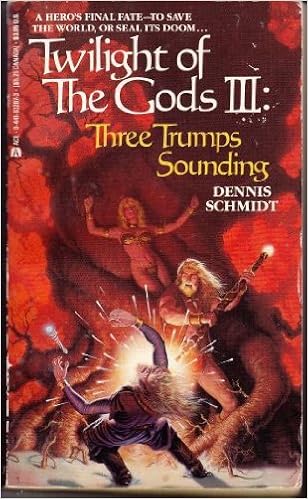
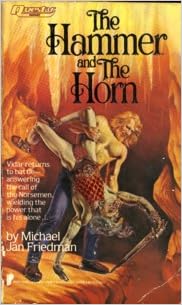
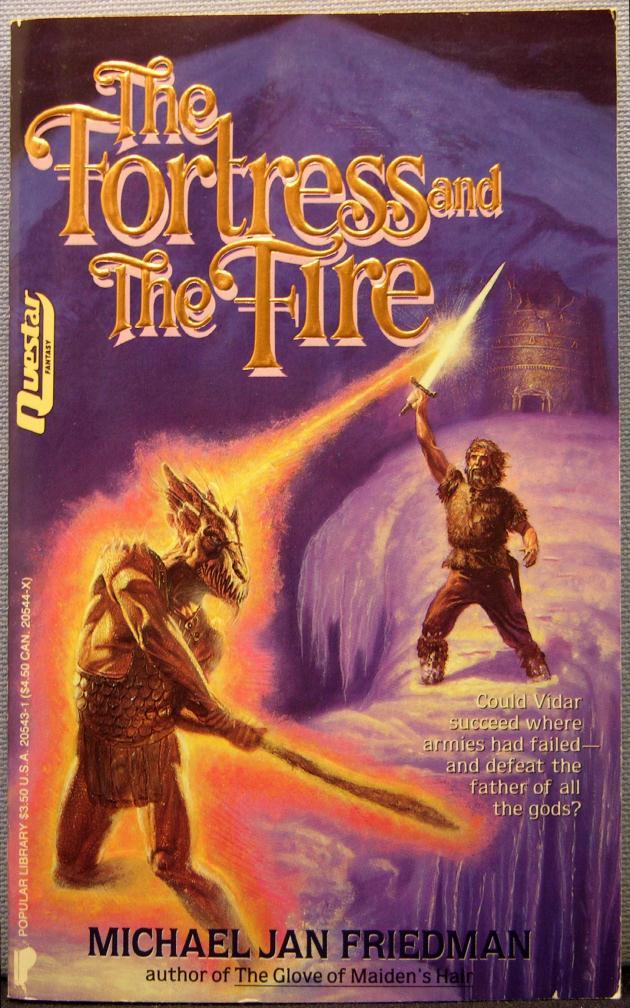
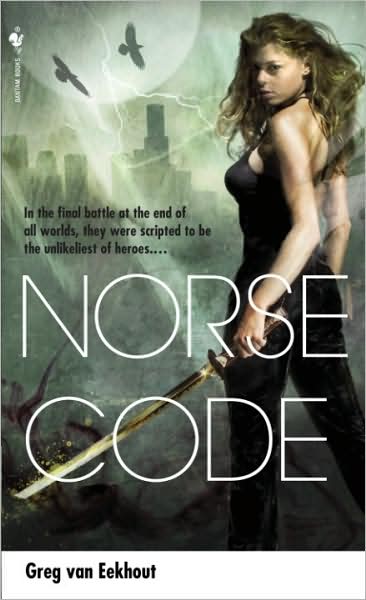
In this vein of expansive storytelling license, there's obviously Marvel's 1962 to now superhero take, but during that period Norse lore has been remixed by other daring authors, which we will survey here: Dennis Schmidt's Twilight of the Gods (1985-1987) trilogy as prequel/re-interpretive, and Michael Jan Friedman's Vidar Trilogy (1985-1988) as sequel (all pre-Neil Gaiman's American Gods [2001] & Odd and the Frost Giants [2008]), and well in advance of some conventions of Marvel and internet Rule 63 by decades. A post-Gaiman/Marvel selection also worthy of mention is Greg Van Eekout's stand-alone novel, Norse Code (2009). The first we'll review in detail, while the last two we'll briefly encapsulate.

Twilight of the Gods:


[Borr versus Surt!]
[Voden at Mimir's Well!]


[Unlike the other two, this cover art has nothing to do with the book.]


In a time of legend a la Robert E. Howard's Conan, where all ancient civilizations abide, so the Nine Norse Worlds instead get recast as other kingdoms and the world at large is itself known as Yggdrasil, the books' map going from northern Europe down to northern Africa, around an as-yet-to-be-flooded smaller Mediterranean. For example the desert dwelling Mesopotamians are the hot kingdom of Muspelheim, which makes for an interesting theory and opens one up to rethinking how strictly the stories we know & love are interpreted.

One theory about the Norse Gods is that instead they were prehistoric heroes who were then gradually euhemerized into divine beings, which is the bold step Schmidt takes with his version, but there's enough magic & supernature in his ancient world to go around.

The story starts with Borr going on an ambitious raid with Surt, and later follows Borr's son, Voden (the obvious Odin analog), on his wandering quest for knowledge, explaining along the way the stories behind his huge catalog of names, something any reader of the Eddas has been bound to wonder but never gotten an answer to. This name accruing thread is a clever & winning conceit.

Samples of interesting changes:

• Volund the Smith instead escapes from his captivity in the Jotun's northern kingdom down into Asaheim.

• The forest-dwelling Vanir are explored fully, their matriarchal society & rituals revealed. Lead by a queen Vanadis & counsel of nine Distingen priestesses, it seems their womanly superiority complex proactively causes friction with their northern plainsmen Aesir neighbors.

• Wicked deceiver Gullveig is not repeatedly speared by Aesir men and burned, but literally gang raped & thrown out, thus irreversibly "burned".

• The Mesopotamian underworld dragon Tiamat is likened to Norse Niflheim-dwelling Nidhogg, which shows how two different peoples can view what may have been ostensibly the same cosmological creature.

Schmidt is no religious studies slouch in these choices, having written an Eastern philosophy-based space opera as well, and integrates shamanic experiences, astral travel, and anthropology in his tellings. Legendary figures from other cultures also appear contemporaneously alongside Voden on his learning curve. Of note is Lao Tzu who wanders into the second book and becomes one of Voden's mentor figures. (And for you "purists" who think the Norse developed in a vacuum, think again -- they traveled the world, met Buddhists, got decorative arts & early shipbuilding from the Celts, and set up house in coastal Portugal.) And with all the dark Mesopotamian demon-summoning know-how, one questions if Schmidt had much exposure to Simon's version of The Necronomicon (1977) ... ?

Delightfully unexpected explanations for the myths we know are given, a joy of revealing the reasons behind the stories throughout all the books:
The water churned and splashed, sending a fine spray high into the air. If one crossed the ford at a certain time of day, when the sun was in the right position, a magnificent rainbow arched across the sky. ~ [p.55, on Bifrosti's Ford (the analog to Bifrost, the rainbow bridge to Asaheim.)]
There are moments where the philosophy floats on the very top of the story, but always as a pertinent aspect of world/character-building as opposed to a deep abstraction.

Included is a homage to Dune (1965) with highly detailed ritual knifefight in Jotun culture, a veiled but profound reference to William Carlos Williams' "The Red Wheelbarrow", and even a nod to the cult film Phantasm (1979)!

While The First Name & Groa's Other Eye seem more well paced with Schmidt re-visioning the murder of Ottar & the marriage of Thor, the stories seem more heavily piled on in the third book as the end approaches as though a checklist were referred to more in the last part of the author's process. One wonders if Schmidt had given himself the leisure of a fourth book whether this might've resulted in pacing those stories deserved, but this middling issue's a small one.

Schmidt's ambitious trilogy covers Voden's story from child to epic hero/magician/legend/apotheosis. At any time one wouldn't look twice at these books which appear just like any other pulp paperback gathering dust to be thrown out for new stock at a used bookstore, but we implore you that if you are a fan of Norse Mythology and fantasy in general, these long-hidden gems should be rescued and added to your library's treasure hoard.

Vidar Trilogy:


Michael Jan Friedman fearlessly remixes the Norse Lore by writing a sequel to the story long after the Eddas end. Odin's son, Vidar, survives Ragnarök and reacts to the war to end all wars by leaving the Aesir behind for a more creative & peaceful life on Midgard. We find our god of vengeance, now inconceivably old but still eternally young, making & selling sculpture as a bohemian artist in NYC. Of course, his past comes back to slowly but surely interfere with his new life.

As things unfold, we discover that Vidar spent much of his intervening lifetimes as a skald, and the narrative is interspersed with flashbacks that show the "true" versions of the great events of Norse legend he remembers from actually being there, versus the ones we got in diluted & altered form told by others, and these variants prove interesting, revealing the gods as different from the ones we know ... .

There are shades of Roger Zelazny's The Chronicles of Amber (1970–1991) in the Aesir, which adds an interfamilial complexity worth discovering.

Norse Code:


[Yes, a smart neo-valkyrie would select a katana.]
Greg van Eekhout's one-novel take on Norse lore finds our present world in strange days: political unrest, extremely weird weather, and the evident erosion of society itself. But the covert NorseCODE genome project knows better, and valkyrie Katy Castillo secretly finds & gathers the descendants of Odin for recruitment into the Aesir's final army that will hopefully save us all.

Along the way she finds wayward god Hermod, now a sort of vagrant wanderer L.A. dude who she enlists to help her go off the reservation and find out what's happened to her sister. There's a modern black humour reminiscent of wry Scandinavian sensibilities, while prophetic world doom quickly races them to the book's very rewarding end.


Unlike the lately released Rick Riordan's Magnus Chase and the Gods of Asgard or the less developed The Blackwell Pages trilogy by Armstrong & Marr, both for the lucrative young adult market, the above selections don't go for a shallow modern adolescent commentary, but celebrate & admire the original material while building soaring structures with newfound aspects on top of the Eddaic foundations.

This Norseplay shows the unshakeable constitution of these influential stories, their polyvalent nature, and the timeless endurance of the Gods.


#   #   # 


While a mostly happy bookstore fixture for over two decades, Guillermo Maytorena IV is currently willing to entertain your serious proposals for employment as a literary/cinema critic, goth journalist, castellan, airship pilot/crewperson, investigative mythologist, or assisting in a craft brewery. Should you be connected to any of the above or equally interesting endeavours, do contact him via LinkedIn or G+.