Search

Showing posts with label Vanir. Show all posts

Friday, April 29, 2016

Dumézil investigates the Gods of the Ancient Northmen.

Georges Dumézil's Gods of the Ancient Northmen surpasses the academic into the realm of poetic & enlightening, like a good professor when he's got love behind his lecture. And of these eight chapters, some actually are taken from Dumézil's lectures.

Published in 1959, this post-doctoral thesis level work of comparative mythology shows French professor Dumézil's thoughtful expansion of the study of Norse lore from the mostly associative philology it was into a functionalist sociology, which invites easier comparisons with the Hindu gods and thus backtracks their migration to the Indo-European.
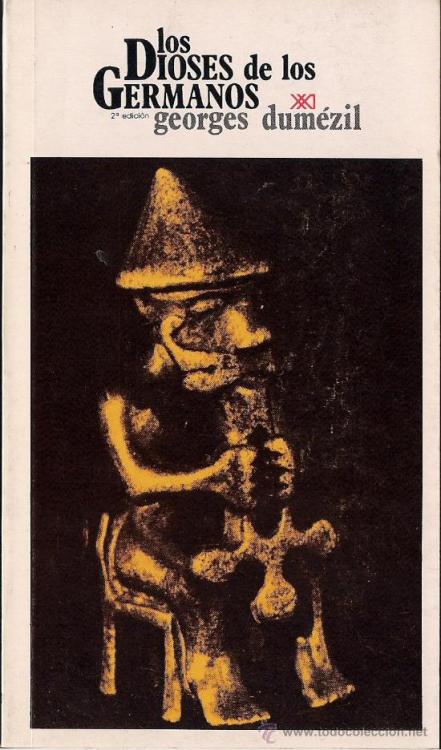


[Spanish edition cover featuring Icelandic Thor.]

Dumézil's trifunctional hypothesis posits that the functions of the gods reflect a society's factional roles, with Odin, Thor, & Frey being the major triumvirate and thus classifying that society's members into rulers, warriors, or farmers, respectively.

Also if modern Indian society is made up of castes, then Dumézil follows that this is a hold-over from Indo-European roles represented by the deities Varuṇa, Indra, & Nasatya, who also have similar functions as Odin, Thor, and Frey, and therefore correspond to those post-migration deities.

Supporting this association, Dumézil shows additional parallels between the tales of Kvasir (a being turned into the intoxicating drink of poetry) and the vedic Mada (a giant who's name means drunkenness), both importantly figuring in the end of a war between factions of the gods (Aesir versus Vanir & the Indian sky versus nature gods), and the Mahabharata's inter-familial struggle of Shakuni tricking Yudhishthira into exile compared to Loki's catspawing of Hodr to kill Baldur among the Aesir (which of course presages Ragnarök, and for the former, the Kurukshetra War).

The author also casts some grim light on the Vanir goddess Nerthus, who according to Roman historian Tacitus' Germania was in a veiled cart and given a procession to visit and bless all the towns before returning to her sacred island. Just before that return however, slaves who bathe the cart & see the goddess are drowned in her lake (!):

"From there comes a mysterious terror, the sacred ignorance of the nature of a secret that is seen only by those who are going to perish." (Tacitus, ch40)

Another reveal mentions the nail in Thor's head depicted in statues (p70), which we'd never run across until finding this illustration online:
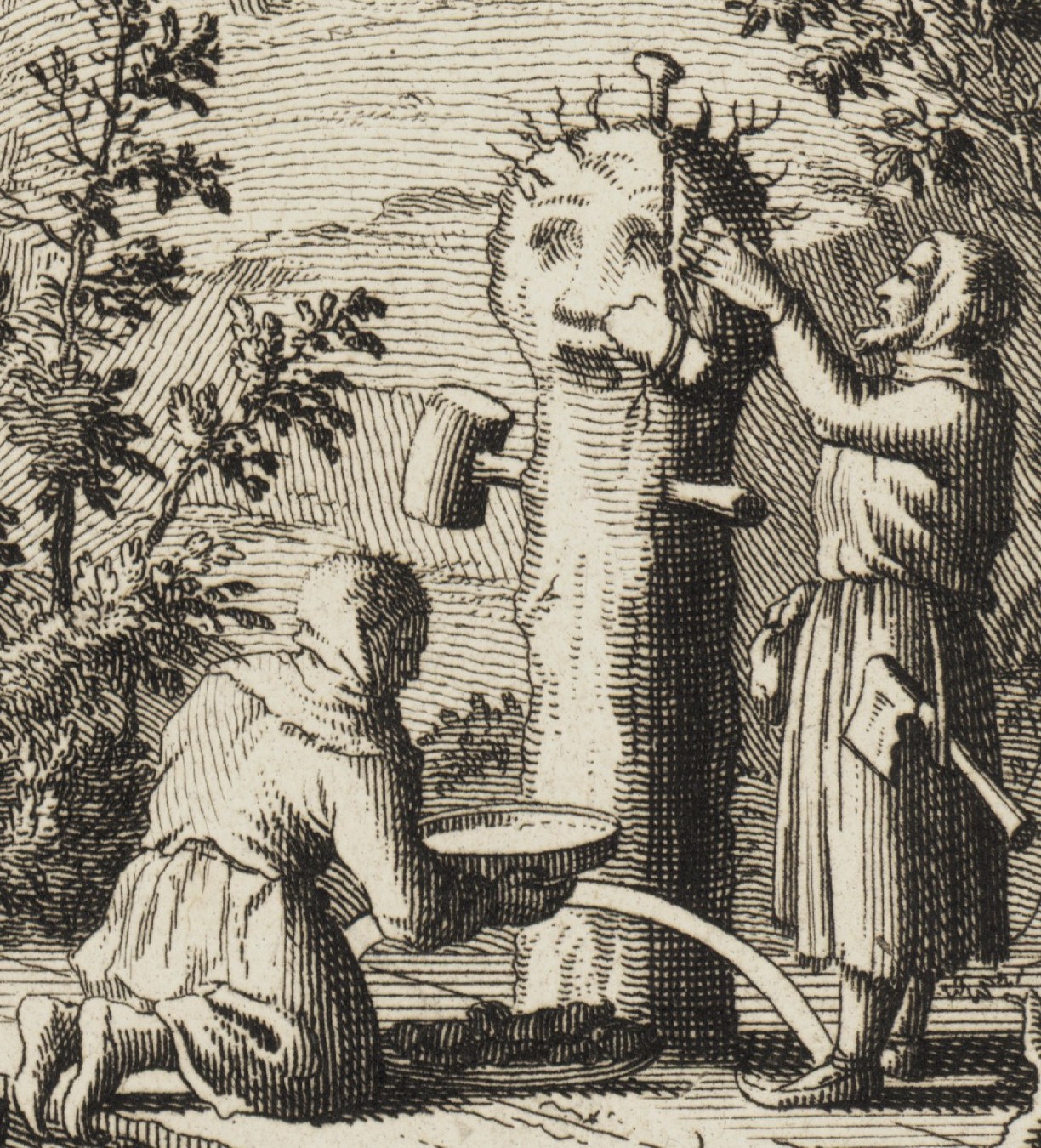

[God pole engraving of Sami storm deity Horagalles ("Thor-Man") with nail in his head hung with whetstone. By Bernard Picart, 1725.]

Dumézil likens the stuck hone from Thor's first formal duel to legendary Irish hero Cu Chulainn's hone-like shaped head "emanation" after his first battle, and would guess that there's a representation of a warrior's rite of passage in this striking similarity.


And Dumézil works out an impressive mental somersault into a what seems to be correct identities for Byggvir & Beyla, two mysterious companions to Frey passingly mentioned in the Lokasenna. From clues in retorts made by Loki, the former male is Barley, and the latter female is the Bee (this conclusion expanded in Dennis Schmidt's erudite & entertaining re-imagining of the Eddas, Twilight of the Gods), both appropriate offerings & personified associates of harvest god Frey.

Heimdall, a god with so many inexplicable epithets, also gets the acute eye of Dumézil's associative reasoning by figuring out that the "whitest of the gods" (compare to Baldur, "brightest of the gods") probably connects with another name for Freya: Mardoll (note the suffixes -dall & -doll), which means sea-light. Heimdall's sea origins come from his nine mothers, the waves, who are the nine daughters of the sea jotuns Ægir & Rán. Sailors say the ninth wave is the roughest, and therefore the most decisive of action, and that many cultures liken the foamy tops of waves to charging white animals. In the case of the Welsh and the sailors' saying, the first eight are ewes, but the strongest is the forceful ram, which gives Heimdall his godly connection with the ram, applicable to his last mother. This is but a few of the explorations Dumézil pulls together on this deity.

Parisian Georges Dumézil (1898-1986) could read Latin by age nine, served as an artilleryman in WWI, earned his doctorate in classics by comparing the Greek divine drink ambrosia with the Indian immortality drink amrita, taught in Istanbul, Uppsala, & France, achieved membership in the prestigious Académie Française, and through most of that time published many, many works on comparative mythology.

Flying in the face of the above curriculum vitae and after reading this study, we feel the tripartite theory is a simplification, an academic's need to place people in boxes using the roles of their major gods to do so. While this mirroring looks great on paper, societies have specialists (i.e. craftspeople, seers, clergy, merchants, scribes, et cetera) that do not fit in such cut & dried classifications. Yet without a time machine or further accounts one cannot discount Dumézil's trifunctional theory. We do note that in old Nordic societies the farmers were also the same warriors who went on viking raids, so while those functions were separate the same individuals did both, as per need or season. Despite this critic's disagreement with the core thesis, there's so much depth & perceptiveness that Dumézil has to teach that even the most hardcore of mythology mavens never knew of, which makes this book so worth learning from.

While there are bilingual side-by-side translations of Icelandic quotations to English, there are also many parts where German, Greek, Latin, French, and others are used but not translated, author & editor expecting their audience to know them. We should be flattered by this presumption, but instead find ourselves quite stymied, and suspect most monoglot readers will be too.

In sum Gods of the Ancient Northmen isn't so much a progression as it is a collection of papers & combined lectures, which leaves no great conclusion, but its amazing examinations can only make us scrutinize & broaden our search for answers.


[One wonders at what other insights could've been discerned if Georges Dumézil had a search engine for his library.]

The individual chapters & exploratory passages all contain great points that are provocative & illuminating. Dumézil's reasonings within Gods of the Ancient Northmen's an impressive thought exercise to get us to continue to think of our divinities in different ways in order to learn more about them -- an intellectual pursuit of insight Odin would totally approve of.

#  #  #

While a mostly happy bookstore fixture for over two decades, Guillermo Maytorena IV is currently willing to entertain your serious proposals for employment as a literary/cinema critic, goth journalist, castellan, airship pilot/crewperson, investigative mythologist, or assisting in a craft brewery. Should you be connected to any of the above or equally interesting endeavours, do contact him via LinkedIn or G+.

Tuesday, March 15, 2016

The Norse Gods Remixed.

The hard truth is that at the end of the post-conversion night, what we mostly have left of the Norse Gods are the Eddas.

And the fact is you want more NorsePlay.

We know from the Eddas' passing references there were tons more stories. And from within an oral tradition, all these tales were surely told & retold in many differing versions with emphasis placed or displaced depending on the audiences' points of interest or the skald's creative leanings. So when Norse Lore believers/followers/fans get bent that so-and-so told it "wrong" or added/subtracted things, there's an ancient & liberal precedent being celebrated with these differences.

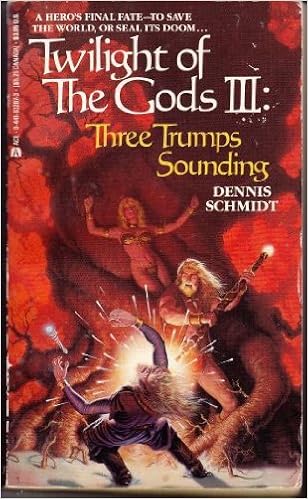
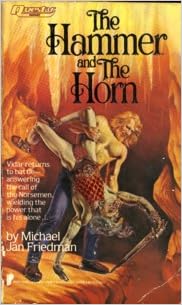
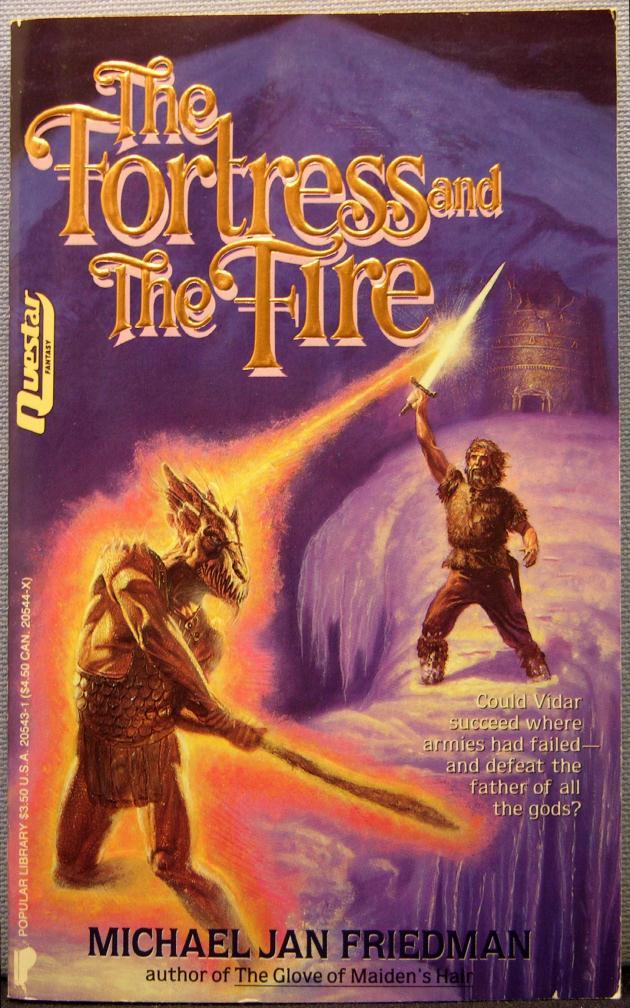
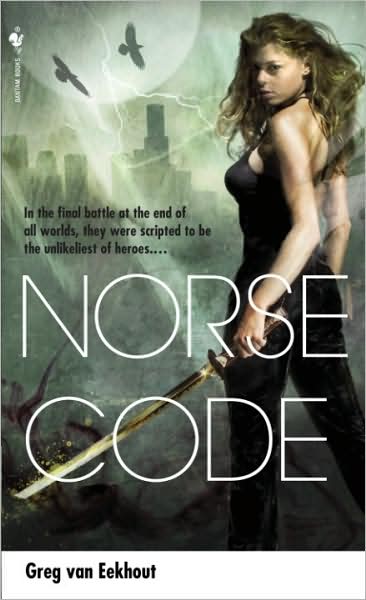
In this vein of expansive storytelling license, there's obviously Marvel's 1962 to now superhero take, but during that period Norse lore has been remixed by other daring authors, which we will survey here: Dennis Schmidt's Twilight of the Gods (1985-1987) trilogy as prequel/re-interpretive, and Michael Jan Friedman's Vidar Trilogy (1985-1988) as sequel (all pre-Neil Gaiman's American Gods [2001] & Odd and the Frost Giants [2008]), and well in advance of some conventions of Marvel and internet Rule 63 by decades. A post-Gaiman/Marvel selection also worthy of mention is Greg Van Eekout's stand-alone novel, Norse Code (2009). The first we'll review in detail, while the last two we'll briefly encapsulate.

Twilight of the Gods:


[Borr versus Surt!]
[Voden at Mimir's Well!]


[Unlike the other two, this cover art has nothing to do with the book.]


In a time of legend a la Robert E. Howard's Conan, where all ancient civilizations abide, so the Nine Norse Worlds instead get recast as other kingdoms and the world at large is itself known as Yggdrasil, the books' map going from northern Europe down to northern Africa, around an as-yet-to-be-flooded smaller Mediterranean. For example the desert dwelling Mesopotamians are the hot kingdom of Muspelheim, which makes for an interesting theory and opens one up to rethinking how strictly the stories we know & love are interpreted.

One theory about the Norse Gods is that instead they were prehistoric heroes who were then gradually euhemerized into divine beings, which is the bold step Schmidt takes with his version, but there's enough magic & supernature in his ancient world to go around.

The story starts with Borr going on an ambitious raid with Surt, and later follows Borr's son, Voden (the obvious Odin analog), on his wandering quest for knowledge, explaining along the way the stories behind his huge catalog of names, something any reader of the Eddas has been bound to wonder but never gotten an answer to. This name accruing thread is a clever & winning conceit.

Samples of interesting changes:

• Volund the Smith instead escapes from his captivity in the Jotun's northern kingdom down into Asaheim.

• The forest-dwelling Vanir are explored fully, their matriarchal society & rituals revealed. Lead by a queen Vanadis & counsel of nine Distingen priestesses, it seems their womanly superiority complex proactively causes friction with their northern plainsmen Aesir neighbors.

• Wicked deceiver Gullveig is not repeatedly speared by Aesir men and burned, but literally gang raped & thrown out, thus irreversibly "burned".

• The Mesopotamian underworld dragon Tiamat is likened to Norse Niflheim-dwelling Nidhogg, which shows how two different peoples can view what may have been ostensibly the same cosmological creature.

Schmidt is no religious studies slouch in these choices, having written an Eastern philosophy-based space opera as well, and integrates shamanic experiences, astral travel, and anthropology in his tellings. Legendary figures from other cultures also appear contemporaneously alongside Voden on his learning curve. Of note is Lao Tzu who wanders into the second book and becomes one of Voden's mentor figures. (And for you "purists" who think the Norse developed in a vacuum, think again -- they traveled the world, met Buddhists, got decorative arts & early shipbuilding from the Celts, and set up house in coastal Portugal.) And with all the dark Mesopotamian demon-summoning know-how, one questions if Schmidt had much exposure to Simon's version of The Necronomicon (1977) ... ?

Delightfully unexpected explanations for the myths we know are given, a joy of revealing the reasons behind the stories throughout all the books:
The water churned and splashed, sending a fine spray high into the air. If one crossed the ford at a certain time of day, when the sun was in the right position, a magnificent rainbow arched across the sky. ~ [p.55, on Bifrosti's Ford (the analog to Bifrost, the rainbow bridge to Asaheim.)]
There are moments where the philosophy floats on the very top of the story, but always as a pertinent aspect of world/character-building as opposed to a deep abstraction.

Included is a homage to Dune (1965) with highly detailed ritual knifefight in Jotun culture, a veiled but profound reference to William Carlos Williams' "The Red Wheelbarrow", and even a nod to the cult film Phantasm (1979)!

While The First Name & Groa's Other Eye seem more well paced with Schmidt re-visioning the murder of Ottar & the marriage of Thor, the stories seem more heavily piled on in the third book as the end approaches as though a checklist were referred to more in the last part of the author's process. One wonders if Schmidt had given himself the leisure of a fourth book whether this might've resulted in pacing those stories deserved, but this middling issue's a small one.

Schmidt's ambitious trilogy covers Voden's story from child to epic hero/magician/legend/apotheosis. At any time one wouldn't look twice at these books which appear just like any other pulp paperback gathering dust to be thrown out for new stock at a used bookstore, but we implore you that if you are a fan of Norse Mythology and fantasy in general, these long-hidden gems should be rescued and added to your library's treasure hoard.

Vidar Trilogy:


Michael Jan Friedman fearlessly remixes the Norse Lore by writing a sequel to the story long after the Eddas end. Odin's son, Vidar, survives Ragnarök and reacts to the war to end all wars by leaving the Aesir behind for a more creative & peaceful life on Midgard. We find our god of vengeance, now inconceivably old but still eternally young, making & selling sculpture as a bohemian artist in NYC. Of course, his past comes back to slowly but surely interfere with his new life.

As things unfold, we discover that Vidar spent much of his intervening lifetimes as a skald, and the narrative is interspersed with flashbacks that show the "true" versions of the great events of Norse legend he remembers from actually being there, versus the ones we got in diluted & altered form told by others, and these variants prove interesting, revealing the gods as different from the ones we know ... .

There are shades of Roger Zelazny's The Chronicles of Amber (1970–1991) in the Aesir, which adds an interfamilial complexity worth discovering.

Norse Code:


[Yes, a smart neo-valkyrie would select a katana.]
Greg van Eekhout's one-novel take on Norse lore finds our present world in strange days: political unrest, extremely weird weather, and the evident erosion of society itself. But the covert NorseCODE genome project knows better, and valkyrie Katy Castillo secretly finds & gathers the descendants of Odin for recruitment into the Aesir's final army that will hopefully save us all.

Along the way she finds wayward god Hermod, now a sort of vagrant wanderer L.A. dude who she enlists to help her go off the reservation and find out what's happened to her sister. There's a modern black humour reminiscent of wry Scandinavian sensibilities, while prophetic world doom quickly races them to the book's very rewarding end.


Unlike the lately released Rick Riordan's Magnus Chase and the Gods of Asgard or the less developed The Blackwell Pages trilogy by Armstrong & Marr, both for the lucrative young adult market, the above selections don't go for a shallow modern adolescent commentary, but celebrate & admire the original material while building soaring structures with newfound aspects on top of the Eddaic foundations.

This Norseplay shows the unshakeable constitution of these influential stories, their polyvalent nature, and the timeless endurance of the Gods.


#   #   # 


While a mostly happy bookstore fixture for over two decades, Guillermo Maytorena IV is currently willing to entertain your serious proposals for employment as a literary/cinema critic, goth journalist, castellan, airship pilot/crewperson, investigative mythologist, or assisting in a craft brewery. Should you be connected to any of the above or equally interesting endeavours, do contact him via LinkedIn or G+.