Search

Showing posts with label book review. Show all posts

Sunday, July 1, 2018

the where of Neverwhere.

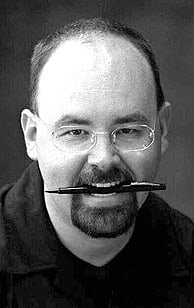
During what was an acceptably charming BBC miniseries in 1996, author Neil Gaiman kept a notebook with him, wherein he decided that all the efforts happening on behalf of his commissioned screenplay deserved a matching novel, and so he wrote Neverwhere.

With the property also being adapted into a graphic novel & BBC radio drama, some half-born rumors that it's going to be movied for the big screen, and Gaiman's announcement in February last year of an in-progress sequel book, such narrative endurance again proves Gaiman is one of our foremost our modern mythographers.


Neverwhere taps into the persistent idea that there's another more fascinating reality below the conscious universe that reflects our unconscious in all its imagination and desire, beneath the skin and bone, the thought under the thought. It's the truth behind that nagging feeling of the apparent world versus the essential.
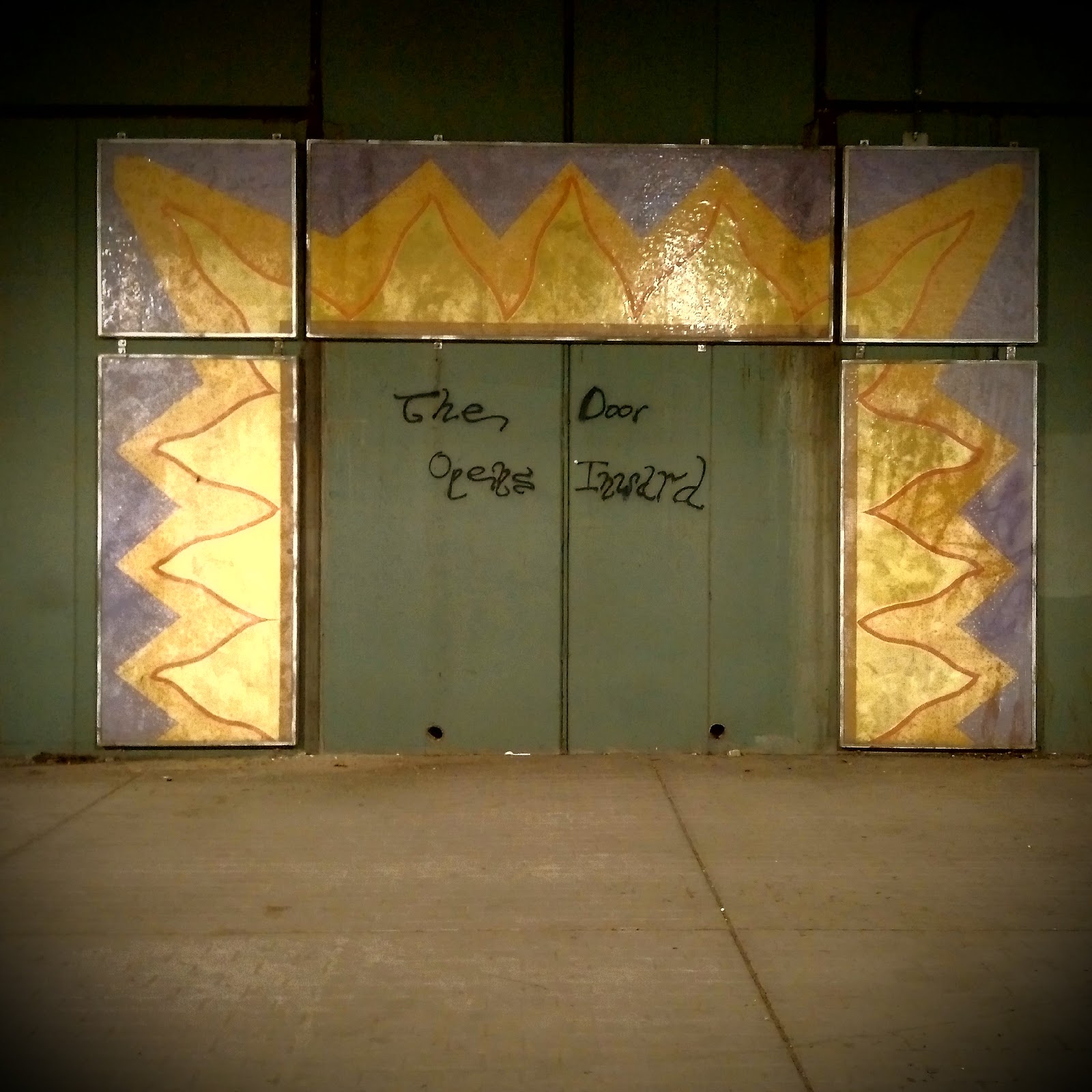


[Tucked to the side of a vagrant haunted Tucson underpass, this installation was enchanted by a sinister elder-styled script with the key "The Door Opens Inward". Photo credit to myself during a dog walk one very dark night.]

Preceeding Neverwhere in this city below concept is Arthur Machen's The London Adventure (citations from the 1924 Knopf hardback):

"... and that fancy is infinitely more impress than fact, partaking, as it does, not of actuality but reality." p.48 
"But I think something happened; that the doors were opened; that the human spirit came into momentary contact with worlds which it is not meant to visit." p.82-83 
"Strangeness which is the essence of beauty is the essence of truth, and the essence of the world. I have often felt that; when the ascent of a long hill brought me to the summit of an undiscovered height in London; and I looked down on a new land." p.152

Like a master storyteller, it's Gaiman's oh-so-proper English style and completely in-passing delivery that gives the tale its voice. It comes off so easy & winning, which is a testament to the forethought and craft behind the work. The following citations from the pagination of the first U.S. edition hardback prove this:


"He continued, slowly, by a process of osmosis and white knowledge (which is like white noise, only more useful), to comprehend the city". p.9 
"A click: the sound of a switchblade opening, empty and lonely and dark." p.19 
"She looked at him rather sadly, like a mother trying to explain to an infant that yes this flame was hot, too. All flames were hot. Trust her, please." p.75
"Then he flexed his fingers, put the pennywhistle to his lips, and began to play an odd, rollicking tune that leapt and twisted and sang. It made Richard feel as if he were thirteen years old again, listening to the Top Twenty on his best friend's transistor radio at school during lunch hour, back when pop music had mattered as it only can in your early teenage years: the marquis's reel was everything he had ever wanted to hear in a song ..." p.125 
"But now, in her dream, that is not happening. Instead, the weasel is reaching out a forepaw toward her, and she is dropping her throwing stick and taking its paw. And then and there, in the undercity beneath Bangkok, they are dancing together, in one intricate unending dance: and Hunter is watching from outside herself, and she is admiring the elaborate movements they make as they move, tail and legs and arms and fingers and eyes and hair all tumbling and twisting powerfully and strangely into the underneath and out across forever." p.192 
"'How old are you?' asked Door. Richard was pleased she had asked; he never would have dared. 'As old as my tongue,' said Hunter, primly, 'and a little older than my teeth.'" p.201
[The Chair of Mysteries sits at the end of a street. One feels as if someone might materialize there when the planes shift and the worlds touch. Found & photographed by myself during another fearless dog walk into a neighborhood no one should live in.]

Recently I had the pleasure of attending the Tucson Steampunk Society's book club meeting for this urban fantasy favourite, which only liminally has some shared subgenre points with steampunk. I hadn't expected it to be livecast & recorded, but I'm glad the TSS got to show off its literary taste & acumen, myself included.

Watch it here.

I enter off camera at 47:37, get asked about my social credentials & am begged to runway model walk my Dark Librarian apron for the Monster Rangers at 51:00, cite the book's most intense moment 1:00:49 with a clever roller-coaster metaphor, orate my perception of the use of mythic time and parallel ideas at 1:16:11, and questioned if would I go to London Below at 1:19:16, which is yes, obviously.


Looking forward to The Seven Sisters, wherein the tale of Neverwhere is continued. 

[TSS is doing Neal Stephenson's The Diamond Age next month, so if you've got serious brilliances to say about this Nanopunk original, do come.]


             #   #   #

11/2018 Addenda: The above pictures have since changed. The Chair of Mysteries has left its nexus point and is missing, and the City of Tucson has misguidedly used our tax dollars to paint over "The Door Opens Inward" label but not the actual graffiti in that same underpass. 


#   #   #

While a mostly happy bookstore fixture for over two decades, Guillermo Maytorena IV is currently willing to entertain your serious proposals for employment as a literary/cinema critic, goth journalist, castellan, airship pilot/crewperson, investigative mythologist, or assisting in a craft brewery. Should you be connected to any of the above or equally interesting endeavours, do contact him via LinkedIn or G+.

Tuesday, September 26, 2017

NorsePlay: A Yank At Valhalla.

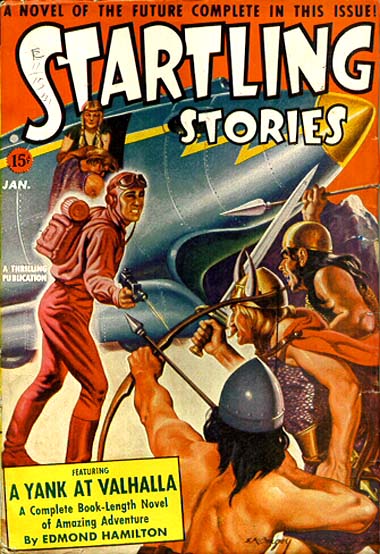
Not to let the hokey Twain-ist title fool you, Edmond Hamilton's A Yank at Valhalla delivers a Norse-inspired genre mash-up in fine pulp style.


[Original pulp from January 1941.]
Part lost civilization fantasy, part science fiction, Hamilton plays with the idea that behind mythology lies a greater truth.
Physicist Keith Masters, during an exploratory survey flight, gets blown into a hidden area of the arctic where he discovers the secret lands of the Norse Gods.


[An Ace double version from 1973.]
Stylewise, the many typos (a pulp given) are unexpectedly balanced out by some lovely .50-cent word selections, and it's neat shifting gears as a reader between scientific terms and medieval descriptors. This integrated juxtaposition aside, a lot of the presentation is stirring with cries of "Our swords for Asgard!", impressive feasting hall settings, and saga worthy melees & martial battles.


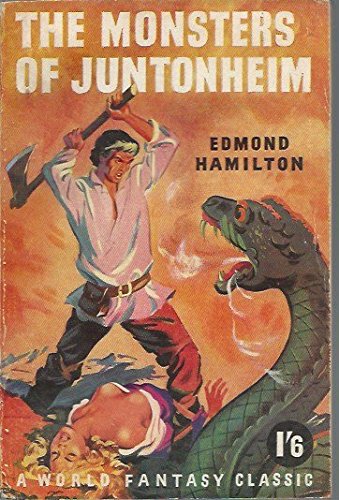
[UK re-titled version from 1950. And Freya's going to fall out of that top at any moment.]
While the start isn't as fast as Lester Del Rey's The Day of the
Giants (1950), they share a conceit that a mid-century modern man can think more clearly and problem solve better than an immortal, which here is still a false conceit, and one finds Masters a few times saying things like, "Score one for my science!" to convince us, but not successfully. Anachronistic of this, Masters flies a "rocket plane", which is more than bleeding edge technology in 1940, even for a well-
funded polar expedition.


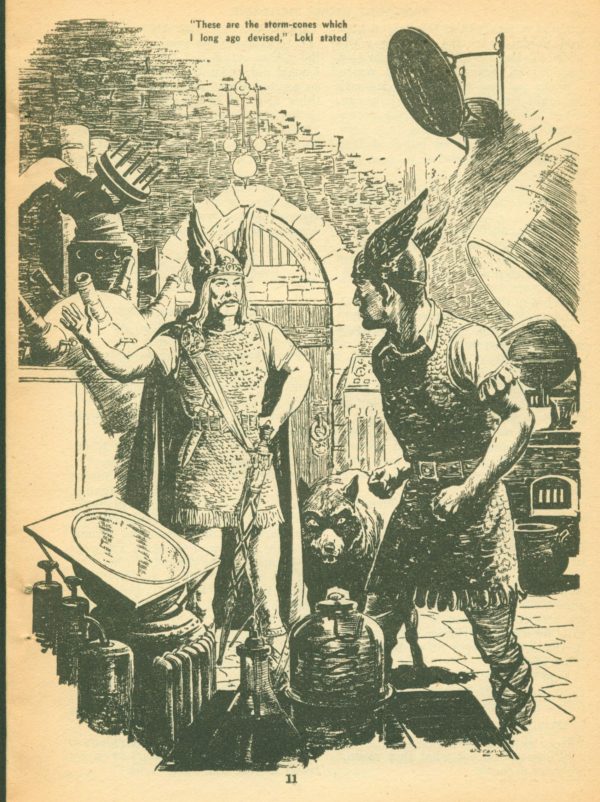
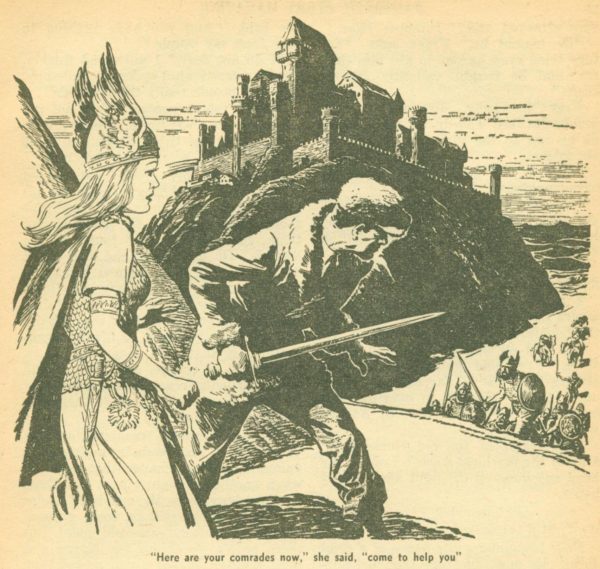
[Interior art from Fantastic Story 1953 January pulp.]
We suspect this early NorsePlay also possibly influenced Ian Cameron's Island At the Top of the World from 1961 where a polar foray stumbles onto a Viking civilization survival. And
the mix of high-tech with ancient dress reminds us of Stan Lee & Jack Kirby's Thor, which began in 1962, where the science is implied, but not overt, and one wonders if either of them read this beforehand.


[More interior art from Fantastic Story 1953 January pulp.]
In terms of what was going on in 1940, we have an American character with no horse in the race between the Aesir & the Jotuns, getting involved for various circumstantial reasons in what may very well become Ragnarok. This raises the question if Hamilton possibly wrote this as an appeal for a
U.S. entry into WW2. While the text always has the battles as being against the odds, the Viking ethos of combat being a necessary facet to support civilization and that risk being celebrated is prominent in the novella.


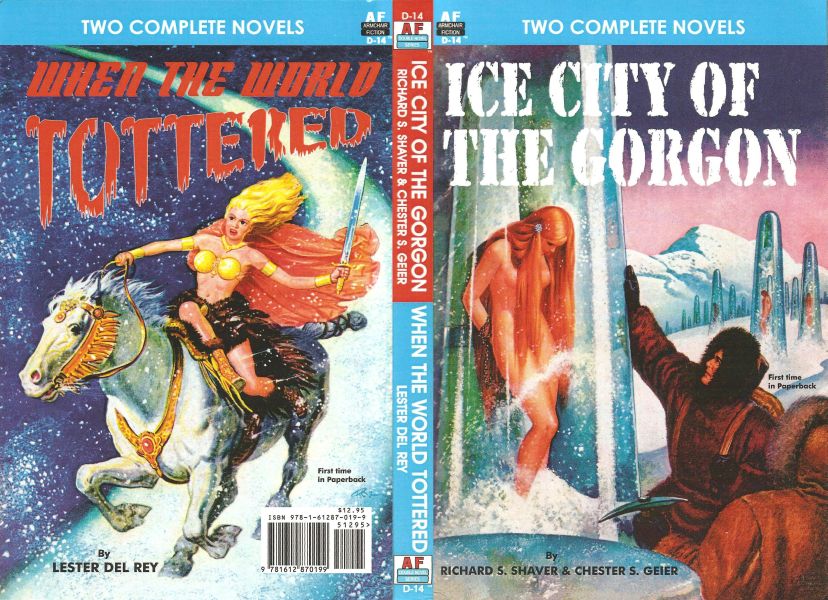
[This same side-saddle valkyrie on colourless Bifrost art was also used for a later NorsePlay: Lester Del Rey's The Day of the Giants, except it was re-titled When the World Tottered.]
With pulp motifs, A Yank at Valhalla also presents the idea of the hidden subterranean. Using the dwarves (here labeled the Alfings) and a radioactive Muspelheim as a pre-surface dwelling and advanced technological world, this presages The Shaver Mystery's pulps/memoirs by half a decade:
"This was no mere cavern, but an enormous hollow such as many have believed was left under the planet's surface by the hurling forth of the Moon." (p.96)

In a current young adult novel landscape of Riordan's Magnus Chase and Armstrong's The Blackwell Pages, where overweening teen sass underqualifies as optimism, going back to an early NorsePlay like Hamilton's A Yank At Valhalla yields more imaginative treasure.


#    #    #


While a mostly happy bookstore fixture for over two decades, Guillermo Maytorena IV is currently willing to entertain your serious proposals for employment as a literary/cinema critic, goth journalist, castellan, airship pilot/crewperson, investigative mythologist, or assisting in a craft brewery. Should you be connected to any of the above or equally interesting endeavours, do contact him via LinkedIn or G+

Friday, March 17, 2017

NorsePlay: Neil Gaiman's "Norse Mythology".

Neil Gaiman faced the daunting task to adapt the narrative holy of the holies, the ur-book stories, the most ancient tales known to man from which all other tales have since flowed from: Norse Mythology.

As we told a childhood friend of Neil's last month, Neil is a fearless writer, that before Neil there wasn't a great movement in the fantasy genre to use the Gods as actual intimate first & close third-person protagonists.


[Neil Gaiman being fearless!]
We look back at his record for this daring talent with reading pleasure: The Sandman (his breakout World Fantasy Award-winning graphic novel series expanding the being of Greek deity Morpheus), American Gods (heavily featuring Gods from various pantheons), and Odd & the Frost Giants (a NorsePlay story for children of all ages). And now, in a tribute to pay back what originally inspired him, Gaiman offers us his version of Norse Mythology.

In his introduction, Neil points out and mourns the loss of many stories in the Norse Lore, with only hints of more left behind in epithets and kennings:


I wish I could retell the tales of Eir, because she was the doctor of the gods, of Lofn, the comforter, who was a Norse goddess of marriages, or of Sjofn, a goddess of love. Not to mention Vor, goddess of wisdom. I can imagine stories, but I cannot tell their tales. (p.14)

You big tease, Mr. Gaiman, as we're pretty sure you could draft some. (And go check out "The Almighty Johnsons" for an interesting take on these goddesses.)


One can't help but hear Gaiman's comfortable English accent while reading. (If you're unfamiliar, listen to this.) Some authors make a total hash of reading their own work (talking to you, departed Douglas Adams), but the words here just rise off the page as though you're listening by a campfire. 


The bar for comparison will always be D'Aulaires' Norse Gods & Giants, but Gaiman instead grew up with Roger Lancelyn Green's Myths of the Norsemen. This early inspiration aside, he sources Snorri Sturluson, the Poetic Edda, and Rudolf Simek's Dictionary of Norse Mythology for his current retelling.


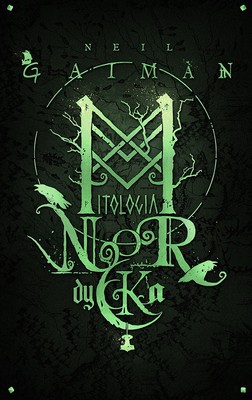
[Fenrir-fraught German edition cover.]
There's an open-endedness to the Norse Lore which allows the teller to detail in the blanks as they see fit. Everyone takes the opportunity to do so, and in this Gaiman is no different. Just when you thought you'd heard all the names for the Gods, he comes up with some original epithets, which is a skaldic achievement.

Charming anachronisms, born of Gaiman's penchant for contemporary urban fantasy (i.e. Neverwhere), make their way into his version of the Eddaic material. For instance, the giant that survives Ymir's flood of lifeblood does so by "clamoring onto a wooden box" (p.32), and smithy dwarf Brokk threatens Loki with converting his head into "A thinking machine (...) Or an inkwell." (p.55) The fact that these modern day items can flow backward and find a place inside these stories only reinforces the Norse Lore's timeless essence.


Other interesting additions and modifications in Gaiman's version include: the cosmic giant Ymir being made neither sex yet hermaphrodite, the detail of runes inscribed on the sides of Utgardaloki's bottomless challenge horn, the rationalization of Odin, Vili, & Ve wanting to create better worlds to live in & thus sanctioning the necessary sacrifice of Ymir to provide realm-building materials to do so, the prick of "Baldur's bell-like laughter...", a new character of Thyrm's conniving sister at Thor's marriage, and Mjölnir winning the the dwarven crafting contest because of its ability to protect, as Gaiman emphasizes that value far above the other entries.


Gaiman also specifically assigns the Vanir's Frey & Freya with the creation of Kvasir, which dovetails nicely into their role as both generative/creative gods and as the members of the post-war tribal exchange.


As the book continues, one can't help but notice Gaiman's enjoyment of writing Loki as a foil for events, especially seen in his extended embellishment of Loki's seduction of the giant's draft horse into something rather sensual.


"The Mead of Poets" is a brilliant standout. The dwarves who kill Kvasir are recast from spiteful miscreants into alchemists, which makes more sense for the murder's resultant beverage. And Bolverkr's underhanded wooing of Gunnlod's done as well as any modern lothario running game on a girl on any given club night.

"Hymir and Thor's Fishing Expedition" partly gets retold as a bad stepfather story, as Tyr's giantess mother marries the abusive & inhospitable Hymir, and we get a taste of Tyr's oppressive early home life.


Hel's half-dead side is descibed as looking into the "pale eye of a corpse" (the exact phrase Gaiman re-uses later for midwinter's brief and distant sun). Gaiman's previous empathetic personification of Death in Sandman may have been partly influenced by her Gothic-forbearer Hel:

"I am only myself, Hel, daughter of Angerboda and of Loki," she said. "And I like the dead best of all. They are simple things, and they talk to me with respect. The living look at me with revulsion."
One can't help but admire Hel's forthright manner, and despite the horror of her condition, she wins us with her self-acceptance, and also wins Odin when he gives her a fitting place in his cosmic scheme of things.

Gaiman reorders events to make more narrative sense. Odin raises the long dead wise woman völva only once, far later in the stories after Balder experiences his plague of nightmares. Gaiman also takes the liberty of making the völva Loki's lover & monster mother jötunness Angrboda, which makes her belligerent & doom-filled revelations to Odin more motivated. This shuffling of prophecy toward the end of things gives the reader a feeling that Ragnarök's too late to stop by the time Odin hears of it, which eliminates the usual planning versus destiny questions of why can't it be avoided if the Gods know about it from so early on in the stories' throughline.


[Hungarian edition.]
Like in Sandman, and in his introduction, Gaiman falls prey to the common slanderous reduction of Thor to a box of hammers ... which ignores Thor's verbally deft outwitting of dwaven Alvíss (actually meaning "All-Wise") to save his daughter Thrud from his amorous attentions, and Gaiman omits this story in his collection. 

A huge deviation in "The Story of Gerd and Frey" is that Gerd's refusal of Frey's proposal is completely skipped. One wonders if the coercion aspect was found to be distasteful by the author, but that's negated anyhow for most modern audiences by her finding mutual happiness with Frey at the end. He is a God of love after all, and being selected by love itself for marriage would be the ultimate compliment.

A serious missed-opportunity occurs in "The Last Days of Loki" when the "Lokasenna" usually takes place. During this episode Loki calls out all the Gods on their transgressions and shortcomings in an attempt to show them they're as mischievous as he is and hypocritical to boot (which is false since Loki's brand of mischief also harms everyone and is born of a darker motivation). Unlike Gaiman's previous writerly use of Loki, he skips the potential of this famous verbal tennis match entirely, which we found disappointing.


[Domestic cover with nordic landscaping.]
During "Ragnarok: The Final Destiny of the Gods", there's a dying exchange between Heimdall & Loki, and a gorgeous post-Ragnarok ending that movingly capstones the book.

Bottom-line: Does Gaiman significantly improve the telling? No, but his telling is respectful, adorned with thoughtful things only he would do, crafted with the fuzzy edges of myth gathered & woven into smoother narratives, poetic yet accessible, and, in many passages, beautiful & wondrous. In that meritorious achievement, Gaiman fulfills the role of that Green version he grew up with, and this new version will be the lens through which the current generation first encounters the All-Father, the Trickster, and the Thunderer. Snorri would be proud.


#      #      #

While a mostly happy bookstore fixture for over two decades, Guillermo Maytorena IV is currently willing to entertain your serious proposals for employment as a literary/cinema critic, goth journalist, castellan, airship pilot/crewperson, investigative mythologist, or assisting in a craft brewery. Should you be connected to any of the above or equally interesting endeavours, do contact him viaLinkedIn or G+.

Tuesday, January 3, 2017

NorsePlay: Lester Del Rey's "Day Of The Giants".

Long out-of-print and originally published in a shorter version titled When The World Tottered in 1950, Lester Del Rey ambitiously tackles the Twilight of the Gods in his 128-page novella.

Most authors take the easy way out by instead writing a story about nearly avoiding doomsday, but Del Rey rises to the challenge and gives the audience the lead-up and final battle ... but perhaps not just as prophesied. A predecessor to Greg van Eekhout's Norse Code, Del Rey delivered Ragnarök fifty years earlier in the genre.

An inexplicably long winter strikes, vexing weathermen, and causing worldwide privation, the results of which start communal breakdown & vigilantism in Leif Svensen's small rural town. Only because of their ancestors' stories do Leif & his recently returned prodigal brother Lee even think to reference Fimbulwinter, and when a mysterious hitchhiker also happens to mention the prophesied world-ending final winter, do the pieces begin to fall into place. 


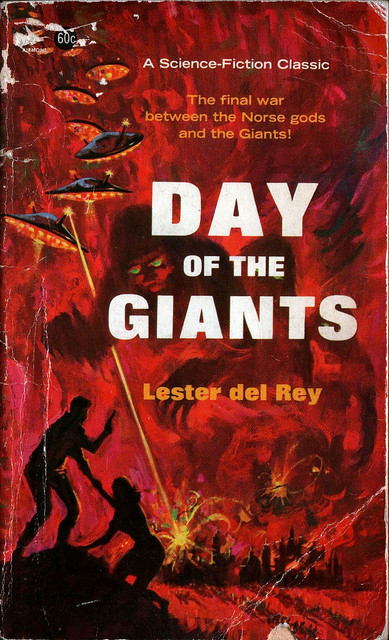
[Airmont Books takes a very misleading artistic licence with the cover art.]

Mismarketed as sci-fi given the completely errant War of the Worlds-style flying saucer attack cover, Day of the Giants is more contemporary fantasy fare, which takes a protagonist of the current day & inserts them into the warp & weft of a magical & ancient hidden under-verse. Leif & Lee are the wildcards that get shuffled into the deck that changes the game of Ragnarök.

The text has a fair share of awkward sentences and typos. But Del Rey was amazingly prolific & possibly didn't have or make time for copy editing in the rush-to-print days of quick 'n' dirty sci-fi pulp, so compared to his contemporaries, it's good on a storytelling level.


[Earlier Armchair Fiction two-fer edition, Valkyrie on Bifrost art by Robert Gibson Jones. Note the odd choice of pairing with Richard Shaver (go look up The Shaver Mystery ... which could have something to do with the Svartalfar, trolls, or huldrafolk, if one applies the lens of Norse Lore to Shaver's cthonic encounters).]
While Del Rey gives protagonist Leif a lot of then-modern American common sense & know-how, we find fault with the idea that any 20th century man would be technologically more savvy than the Gods, especially given they're cited to be 50,000 years old in the story. That they would not advance, even with a very restrictive cultural adherence, stretches credulity.

On the other hand, there are some really creative additions to the mythology that add to & fill in some blanks:

• That the Valkyries used an Alfheim magic to breathe an "elf seed", or regenerative flesh, into their chosen fallen, which is then drawn out to regenerate the hero whole back in Asgard. The new "elf flesh" then allows them to fight, die, and be reassembled at battle practice day's end.

• Freya's falcon cloak is in origin elf-made (perhaps given her brother's rulership of Alfheim?).

• Thor's hammer Mjölnir has magnetic properties which allows it to disarm others if it passes by an enemy's metal weapon. (*Yoink*!)

• Decades before the Marvel Film's "Thor" & "Thor: The Dark World" adaptations, Bifrost is not only a dimensional connector to earth/Midgard, but to all the Nine Worlds.

These extrapolations show Del Rey did a fair amount of thinking and his Edda homework. While there are some mistakes, reassignments of lore roles, and willful omissions to skip lengthy background explanations for the novella format, Del Rey garnishes his text with some lesser-used epithetical Gods' names, place references, and details that would make Snorri Sturluson proud.


[Avalon 1959 hardback cover art by Emsh. Note the misspelling of Del Rey's surname.]

In Del Rey's 1950s Atom Age, technology & the modernist future were ideals to be pursued, the new secular science replacing the old religious beliefs, and here he uses the Gods as a foil for that moral: Some traditions need to be re-examined if they stop a more useful progress. Yes, that's totally unfair to retroactively impose that ideal on the Norse Gods, especially since they inspired cultures that invented seafaring & navigational innovations to travel the world over, themselves bore the first smart weapons (i.e Gungnir, Mjölnir, & Sumarbranderinto battle, and created fish nets. But again Del Rey presents the Gods as nearly frozen in their personas & ways, so only in the context of his book can he get away with it.

Despite this then-contemporary misapplication, Del Rey's Day of the Giants is a fun read, his imaginative addenda to the lore is inspired, and seeing the details of the story NorsePlay'd out in the fateful tale of Ragnarök is rather worth it.


#     #     #

While a mostly happy bookstore fixture for over two decades, Guillermo Maytorena IV is currently willing to entertain your serious proposals for employment as a literary/cinema critic, goth journalist, castellan, airship pilot/crewperson, investigative mythologist, or assisting in a craft brewery. Should you be connected to any of the above or equally interesting endeavours, do contact him via LinkedIn or G+.

Tuesday, March 15, 2016

The Norse Gods Remixed.

The hard truth is that at the end of the post-conversion night, what we mostly have left of the Norse Gods are the Eddas.

And the fact is you want more NorsePlay.

We know from the Eddas' passing references there were tons more stories. And from within an oral tradition, all these tales were surely told & retold in many differing versions with emphasis placed or displaced depending on the audiences' points of interest or the skald's creative leanings. So when Norse Lore believers/followers/fans get bent that so-and-so told it "wrong" or added/subtracted things, there's an ancient & liberal precedent being celebrated with these differences.

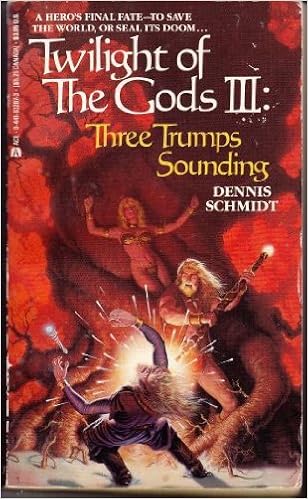
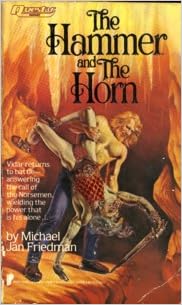
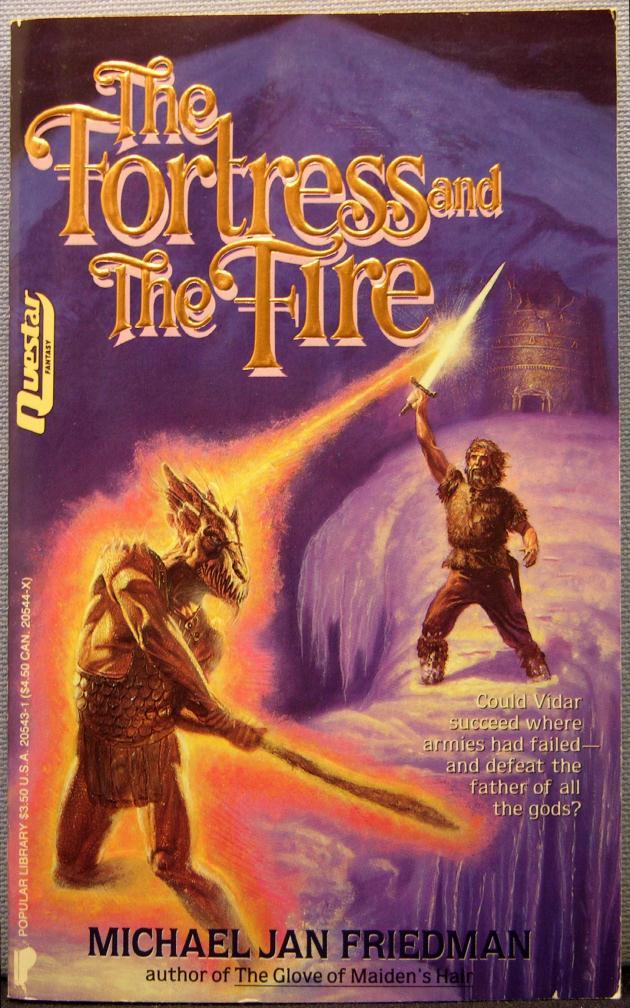
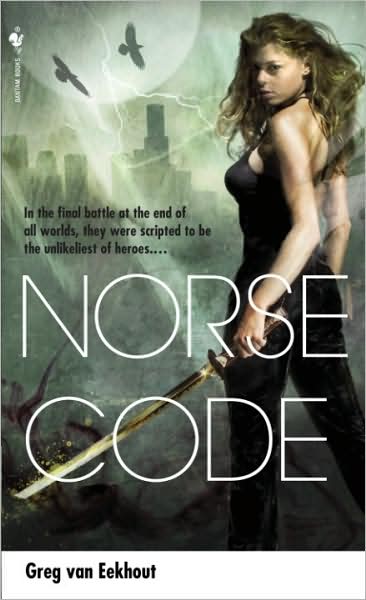
In this vein of expansive storytelling license, there's obviously Marvel's 1962 to now superhero take, but during that period Norse lore has been remixed by other daring authors, which we will survey here: Dennis Schmidt's Twilight of the Gods (1985-1987) trilogy as prequel/re-interpretive, and Michael Jan Friedman's Vidar Trilogy (1985-1988) as sequel (all pre-Neil Gaiman's American Gods [2001] & Odd and the Frost Giants [2008]), and well in advance of some conventions of Marvel and internet Rule 63 by decades. A post-Gaiman/Marvel selection also worthy of mention is Greg Van Eekout's stand-alone novel, Norse Code (2009). The first we'll review in detail, while the last two we'll briefly encapsulate.

Twilight of the Gods:


[Borr versus Surt!]
[Voden at Mimir's Well!]


[Unlike the other two, this cover art has nothing to do with the book.]


In a time of legend a la Robert E. Howard's Conan, where all ancient civilizations abide, so the Nine Norse Worlds instead get recast as other kingdoms and the world at large is itself known as Yggdrasil, the books' map going from northern Europe down to northern Africa, around an as-yet-to-be-flooded smaller Mediterranean. For example the desert dwelling Mesopotamians are the hot kingdom of Muspelheim, which makes for an interesting theory and opens one up to rethinking how strictly the stories we know & love are interpreted.

One theory about the Norse Gods is that instead they were prehistoric heroes who were then gradually euhemerized into divine beings, which is the bold step Schmidt takes with his version, but there's enough magic & supernature in his ancient world to go around.

The story starts with Borr going on an ambitious raid with Surt, and later follows Borr's son, Voden (the obvious Odin analog), on his wandering quest for knowledge, explaining along the way the stories behind his huge catalog of names, something any reader of the Eddas has been bound to wonder but never gotten an answer to. This name accruing thread is a clever & winning conceit.

Samples of interesting changes:

• Volund the Smith instead escapes from his captivity in the Jotun's northern kingdom down into Asaheim.

• The forest-dwelling Vanir are explored fully, their matriarchal society & rituals revealed. Lead by a queen Vanadis & counsel of nine Distingen priestesses, it seems their womanly superiority complex proactively causes friction with their northern plainsmen Aesir neighbors.

• Wicked deceiver Gullveig is not repeatedly speared by Aesir men and burned, but literally gang raped & thrown out, thus irreversibly "burned".

• The Mesopotamian underworld dragon Tiamat is likened to Norse Niflheim-dwelling Nidhogg, which shows how two different peoples can view what may have been ostensibly the same cosmological creature.

Schmidt is no religious studies slouch in these choices, having written an Eastern philosophy-based space opera as well, and integrates shamanic experiences, astral travel, and anthropology in his tellings. Legendary figures from other cultures also appear contemporaneously alongside Voden on his learning curve. Of note is Lao Tzu who wanders into the second book and becomes one of Voden's mentor figures. (And for you "purists" who think the Norse developed in a vacuum, think again -- they traveled the world, met Buddhists, got decorative arts & early shipbuilding from the Celts, and set up house in coastal Portugal.) And with all the dark Mesopotamian demon-summoning know-how, one questions if Schmidt had much exposure to Simon's version of The Necronomicon (1977) ... ?

Delightfully unexpected explanations for the myths we know are given, a joy of revealing the reasons behind the stories throughout all the books:
The water churned and splashed, sending a fine spray high into the air. If one crossed the ford at a certain time of day, when the sun was in the right position, a magnificent rainbow arched across the sky. ~ [p.55, on Bifrosti's Ford (the analog to Bifrost, the rainbow bridge to Asaheim.)]
There are moments where the philosophy floats on the very top of the story, but always as a pertinent aspect of world/character-building as opposed to a deep abstraction.

Included is a homage to Dune (1965) with highly detailed ritual knifefight in Jotun culture, a veiled but profound reference to William Carlos Williams' "The Red Wheelbarrow", and even a nod to the cult film Phantasm (1979)!

While The First Name & Groa's Other Eye seem more well paced with Schmidt re-visioning the murder of Ottar & the marriage of Thor, the stories seem more heavily piled on in the third book as the end approaches as though a checklist were referred to more in the last part of the author's process. One wonders if Schmidt had given himself the leisure of a fourth book whether this might've resulted in pacing those stories deserved, but this middling issue's a small one.

Schmidt's ambitious trilogy covers Voden's story from child to epic hero/magician/legend/apotheosis. At any time one wouldn't look twice at these books which appear just like any other pulp paperback gathering dust to be thrown out for new stock at a used bookstore, but we implore you that if you are a fan of Norse Mythology and fantasy in general, these long-hidden gems should be rescued and added to your library's treasure hoard.

Vidar Trilogy:


Michael Jan Friedman fearlessly remixes the Norse Lore by writing a sequel to the story long after the Eddas end. Odin's son, Vidar, survives Ragnarök and reacts to the war to end all wars by leaving the Aesir behind for a more creative & peaceful life on Midgard. We find our god of vengeance, now inconceivably old but still eternally young, making & selling sculpture as a bohemian artist in NYC. Of course, his past comes back to slowly but surely interfere with his new life.

As things unfold, we discover that Vidar spent much of his intervening lifetimes as a skald, and the narrative is interspersed with flashbacks that show the "true" versions of the great events of Norse legend he remembers from actually being there, versus the ones we got in diluted & altered form told by others, and these variants prove interesting, revealing the gods as different from the ones we know ... .

There are shades of Roger Zelazny's The Chronicles of Amber (1970–1991) in the Aesir, which adds an interfamilial complexity worth discovering.

Norse Code:


[Yes, a smart neo-valkyrie would select a katana.]
Greg van Eekhout's one-novel take on Norse lore finds our present world in strange days: political unrest, extremely weird weather, and the evident erosion of society itself. But the covert NorseCODE genome project knows better, and valkyrie Katy Castillo secretly finds & gathers the descendants of Odin for recruitment into the Aesir's final army that will hopefully save us all.

Along the way she finds wayward god Hermod, now a sort of vagrant wanderer L.A. dude who she enlists to help her go off the reservation and find out what's happened to her sister. There's a modern black humour reminiscent of wry Scandinavian sensibilities, while prophetic world doom quickly races them to the book's very rewarding end.


Unlike the lately released Rick Riordan's Magnus Chase and the Gods of Asgard or the less developed The Blackwell Pages trilogy by Armstrong & Marr, both for the lucrative young adult market, the above selections don't go for a shallow modern adolescent commentary, but celebrate & admire the original material while building soaring structures with newfound aspects on top of the Eddaic foundations.

This Norseplay shows the unshakeable constitution of these influential stories, their polyvalent nature, and the timeless endurance of the Gods.


#   #   # 


While a mostly happy bookstore fixture for over two decades, Guillermo Maytorena IV is currently willing to entertain your serious proposals for employment as a literary/cinema critic, goth journalist, castellan, airship pilot/crewperson, investigative mythologist, or assisting in a craft brewery. Should you be connected to any of the above or equally interesting endeavours, do contact him via LinkedIn or G+.
Monday, January 11, 2016

Zafóning into The Mist Trilogy.

We wanted to eschew reading any more young adult titles, but at the end of The Shadow of the Wind author Carlos Ruiz Zafón narratively fishhooks us by noting that hero character Daniel Sempere grows up and goes on to write The Prince of Mist -- which just happens to be the title of the first of Zafón's YA books. Thus we are caught by the twin barbs of curiosity & compulsion to know if these juvenile works actually have relevance to his masterful adult ones.

Yet in this baiting of our reading cues, we find that while good, Zafón's YA falls a grade just below the texture & completeness of his other The Cemetery of Forgotten Books trilogy. There's the same edgy anticipations, looming gothic structures, innocent characters threatened by past tragedies, and all the darkly delightful earmarks, but it's Zafón-lite. Still, Zaf
ón-lite is better than most other authors on their most gravitas of writing days. 


[Slightly more defined import cover figure than on the U.S. version.]

The Prince of Mist

From the author's opening note:


"I like to believe storytelling transcends age limitations, and I hope readers of my adult novels will be tempted to explore these stories of magic, mystery, and adventure."

A classic R.L. Stevenson thing to say, and entirely appropriate.

This first installment's nothing less than Bradberryesque, a childhood-that-never-was small town paene in the vein of Something Wicked This Way Comes, complete with an equivalent parallel to Mr. Dark, and as sinister a group as Darren Shan's Cirque Du Freak could muster. Like these other two, there are elements that are brutally adult, and like all great children's books, they strive to appeal to all ages so they can both awe the young with their dark wonder, and stand the weathering test of acidic maturity.

Zafón almost spares us the YA trope of orphans, but maintains one character, Roland, as having lost his parents to an accident. Beachcomber Roland befriends seaside town newcomer Max, and by association, his unignorable lovely sister Alicia, which of course makes for a strained relationship dynamic:


"Hey," Max hissed at him. "She's my sister, not a piece of cake. Okay?" [ch 6, p.65] 

As the children's summertime unfolds, weird inexplicable events begin to happen in their old house with a mysterious past, and the search for answers begins. 

When the novella progresses and we just begin to see the adversary, carnival leader Cain's powers are never really defined, and his threat becomes too powerful, and his villainous behaviour too Snidely Whiplash arch, with his motives far less clear than foreclosure or banging virginal Nell:


"In an infinite universe, there were too many things that escaped human understanding." [ch 12, p.147]

Unlike Zafón's The Angel's Game, where a loose magical realism and far more complete style frames the narrative, the above quote allows Cain a limitless supernatural might, which stretches credulity, and makes his lines feel more comic book caricature than realized literary character. 


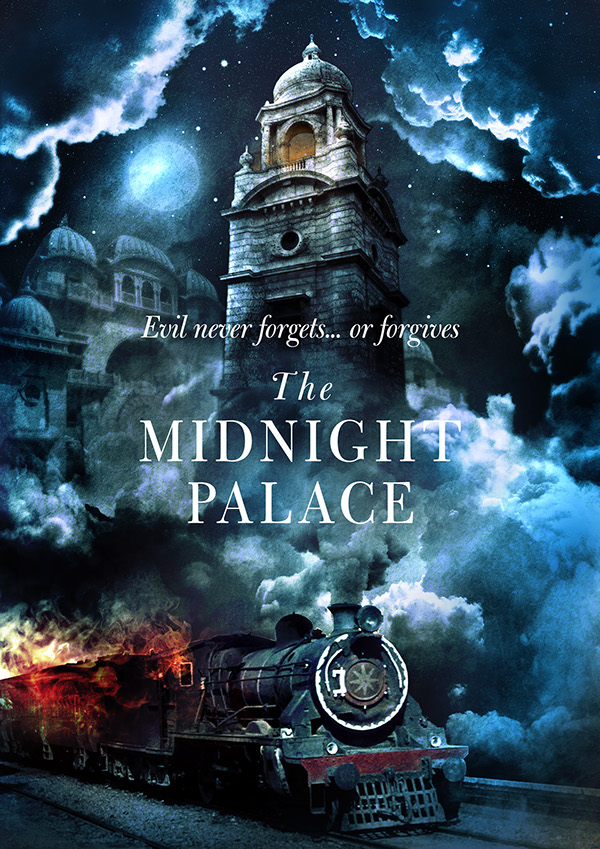
The Midnight Palace

An even more marked departure from Zafón's familiar home Barcelona, surprisingly set in a past exotic Calcutta, this middle book launches the reader into a vicious in media res beginning chase. This is an English imperial novella, but with some parallels of India pre-liberation to the author's native post-Spanish Civil War. The pacing's quickly constructed, and up & running from the get go.

Starring a cadre of precocious Indian children you so wished were your intellectually wisecracking friends, at childhood's end on the eve of their graduation from a Christian orphanage, we discover they also have in common The Chowbar Society: A secret clique mutually dedicated to aiding each other, meeting in a nearby abandoned house they've dubbed The Midnight Palace, where they sneak off to tell ghost stories, personal confessions, and problem solve. It is this altruistic society that runs up against hunter-villain Jawahal, a dark pyromancer, who, for unknown reasons, is after their new friend Sheere.

In contrast to the pacing, Zafón unfolds the mystery with tantalizing slowness, and the reader is compelled through urban Calcutta to follow these youths to a deadly and long hidden truth.

The Midnight Palace, a place plainly dilapidated with abandoned neglect by day, but is imbued with evocative magic for the teens by night, itself displays Zafón's love of architecture:


"The place exuded that aura of magic and dreams that rarely exists beyond the blurred memories of our early years." [p.79]

The celebratory ornaments of buildings easily slides into the spectrum of the sinister in many other of the book's settings, so the wonder is equally matched, and at times outdone, by the spooky.


Like Star Wars' prequel trilogy, the narrative arc becomes about the antagonist as its his slowly revealed history that frames the narrative and motivates the Chowbar Society's desperate investigations. This antagonist's similarities to the first book also place them as a shade too arch, more of a Freddy Kruger entity, nightmarish, complete with a boiler (for real). This final unveiling nearly undermines all the exotic delight and panoply of characters the book otherwise has. And in this strength alone, Zafón could easily write a series of Chowbar Society stories, the construct is so winning, but we only get this one.


The Watcher in the Shadows


Of the three, this mostly resembles his adult works, which makes sense as he wrote it last. Zafón again departs from his Catalanes setting into nearby Normandy, France.

With many similarities to Prince, we follow a family with even more unfortunate circumstances to a small coastal town where widow Simone takes a household managing post for an eccentric genius toymaker, as her children Irene & Dorian adjust to their new home nearby.

Zafón delivers yet another wonderful mansion setting full of spooky automata, but laced with pathos:


"As she listened to the toymaker’s words, Irene realised she would no longer be able to view Cravenmoore as the magnificent product of a boundless imagination, the ultimate expression of the genius that had created it. Having learned to recognise the emptiness of her own loss, she knew this place to be little more than the dark reflection of the solitude that had overwhelmed Lazarus during the past twenty years. Every piece of that marvellous world was a silent tear." [p.23]

And if you're reading Mists as we were for its connection to The Cemetery of Forgotten Books, Andreas Corelli gets mentioned in passing, and so the tie-in (two books later!) is finally revealed. Also the villain's nature more closely ties this third installment in with Mist but less so with Midnight.

As far as connections that make this a trilogy, the ability to "shadow" in the Zafóniverse results in similar adversaries in all three, and the Faustian bargaining exhibited in The Angel's Game strikes the same chord through these books. In both trilogies Zafón persistently explores the sins-of-the-father, and the quest of the innocent to both uncover & escape the horrors of generations past. The cost of doing so is always that same innocence.


[Zafón is the man!]
Not as complex, not as ornate, but one can see the formative merits as Zafón cuts his chops in this earlier material and the building of the writing to come. The comparison of earlier to later books is perhaps unfair as these are intended for a younger audience, but given the aforementioned fishhook, adults will be compelled to pick them up just to see if the later story seeds from The Mists Trilogy. Yet one can easily imagine that if Zafón had incubated these awhile longer & re-drafted, they very well might have had the same impact as his adult literature.


#     #     #

While a mostly happy bookstore fixture for over two decades, Guillermo Maytorena IV is currently willing to entertain your serious proposals for employment as a literary/cinema critic, goth journalist, castellan, airship pilot/crewperson, investigative mythologist, or assisting in a craft brewery. Should you be connected to any of the above or equally interesting endeavours, do contact him via LinkedIn or G+.
Tuesday, November 17, 2015

Chasing Magnus through the Norse Lore.

The unwritten criticism of young adult offerings (and it's not a genre, it's a market) is that none ever seem to pass the bar of its progenitor J.K. Rowling -- all else that follows Harry Potter's been derivative. Nor have they been able to strike such a grand balance between character & world-building as Rowling.

That bar still remains unapproached by Rick Riordan's latest trilogy series launch, Magnus Chase and the Gods of Asgard: The Sword of Summer, though you'd think with the richness of Norse Lore to draw from it might surpass the young wizard, but Magnus makes for a fun read.

Much like Riordan's Percy Jackson series, our titular protagonist has a mystery daddy, is a streetwise kid, has an important prophecy at age 16 event to propel their plot, and much internal thought reactions of sophomoric adolescent "smartness" in their texts for the teen reader & young-at-heart to identify with.

And our newly chosen hero & his varied party of gifted friends must accomplish a quest by a deadline for a lost object. Since Homer, or Tolkien, however, we never tire of this story's formula.

In contemporary fantasies our modern interpolations on ancient legends are where the humour's supposed to come from. Would today's modern man appreciate Valhalla? Maybe if it were turned into a hotel is Riordan's answer. And the pop culture references are meant to give enough perspective for a young & modern audience to see Riordan's pushing forward of the long-hidden denizens of the Nine Norse Worlds, but push the results of this technique ten years on and it might read more dated than classic. 

Where Magnus really shines is when it provides other unthought of specifics & fill-ins, such as an actual descriptor of the taste of Mimir's well of knowledge, or elaborating on the current results of Freya's bartering with the dwarven Brisings, adding to the list of "paradox ingredients", or the unique physics of Jotunheim.
"The smell of the giants' body odor -- a combination of wet clay and sour meat ..." [p.388]
These new imaginings give the reader some nice mythological extras.

Another cool hard copy reader extra (because real books will always rule!) is that depending where you buy your copy, you actually get something extra: If off a pallet at CostCo, it's a bookmark. If from the shelf of Barnes & Noble, it's a small pamphlet guide to the Norse Gods. If from the bestseller rack at Target, it's a mini-poster of the Nine Worlds. And there's even a limited edition slipcased version if you order yours from Amazon UK.

Points in the plot borrow many episodes in Norse Lore but instead place Magnus & Co within them, so if you've read the original stories you'll be the inside reader:


"We met at that party at Bilskirner -- the one where you were playing tug-of-war with Loki?" 
"Oh ... ." [He] shook his horns. "Yes. That was embarrassing." [p.343]

... but not so surprised, and if you haven't read the stories the narrative will be new ... but weirdly seeming a bit forced. There's a familiar eagle dragging a character, some fishing for a large sea monster, a deception by giantesses, et cetera. Some of the comparative situations are funny, while others fall flat from trying too hard.

For Rick Riordan fans, Annabeth Chase from Percy Jackson cameos, turning out to be Magnus' cousin. This also implies a shared universe which might lead to a conflict between the pantheons ... ? Maybe even a duel between Percy & Magnus? (A Red Gold on Magnus! Sumarbrander totally breaks Riptide.)


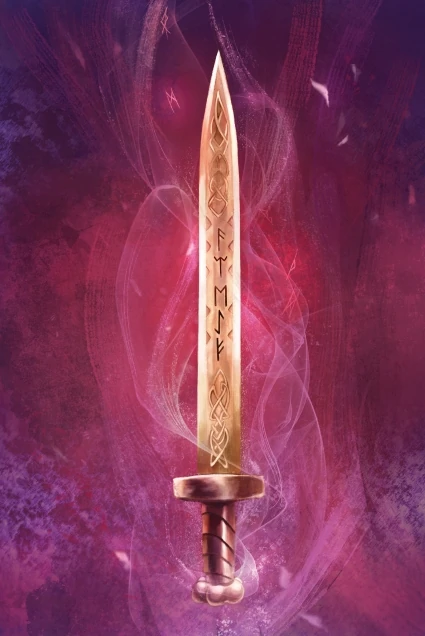
[Sumarbrander!] 
While in the Lore the monsters are universal forces of entropy & destruction, in Riordan's worlds they are external manifestations of our fears & anxieties amplified, reflections of fault & weakness & regret, giving the characters' encounters with them a more crushingly personal aspect.

And in an interesting setting decision, Texan Rick Riordan celebrates his own Boston transplantation by imbuing Beantown with a close connection to Yggdrasil, the World Tree, thus making the northeastern city a crossroads to getting from Midgard, our world, to the other Nine Worlds.

In contrast to the Lore, sometimes the book puts itself at odds with the lessons in the original stories. Odin teaches that knowledge sometimes requires levels of personal & impersonal sacrifice, but Magnus questions this and frequently whines & opines differently as he proceeds on his quest.

We would adore it if Magnus Chase were to give kids & adults new to the epic accounts of the Norse Gods the same wonder & fascination that we got from D'Aulaires' Norse Gods & Giants (which really still stands as the best [even if Magnus currently outsells it on Amazon]) when we were growing up, and enough to direct them to later go read the Eddas where they came from. In all, Riordan, previously a teacher by trade, has written an entertaining embroidery of the lore that hopefully opens this door to Asgardian narratives.

Part two of the Magnus Chase trilogy, The Hammer of Thor, is scheduled for release October 4th, 2016. We can only hold out a reader's hope that this upcoming literary Mjölnir can finally smash Potter's wand.


#  #  #

While a mostly happy bookstore fixture for over two decades, Guillermo Maytorena IV is currently willing to entertain your serious proposals for employment as a literary/cinema critic, goth journalist, castellan, airship pilot/crewperson, investigative mythologist, or assisting in a craft brewery. Should you be connected to any of the above or equally interesting endeavours, do contact him.