Search

Showing posts with label re-purposing mythology. Show all posts

Tuesday, January 3, 2017

NorsePlay: Lester Del Rey's "Day Of The Giants".

Long out-of-print and originally published in a shorter version titled When The World Tottered in 1950, Lester Del Rey ambitiously tackles the Twilight of the Gods in his 128-page novella.

Most authors take the easy way out by instead writing a story about nearly avoiding doomsday, but Del Rey rises to the challenge and gives the audience the lead-up and final battle ... but perhaps not just as prophesied. A predecessor to Greg van Eekhout's Norse Code, Del Rey delivered Ragnarök fifty years earlier in the genre.

An inexplicably long winter strikes, vexing weathermen, and causing worldwide privation, the results of which start communal breakdown & vigilantism in Leif Svensen's small rural town. Only because of their ancestors' stories do Leif & his recently returned prodigal brother Lee even think to reference Fimbulwinter, and when a mysterious hitchhiker also happens to mention the prophesied world-ending final winter, do the pieces begin to fall into place. 
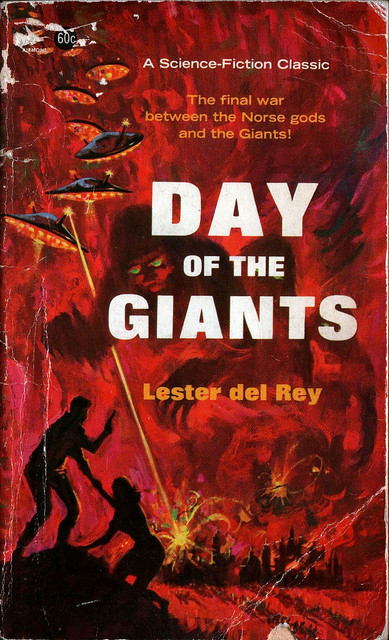

[Airmont Books takes a very misleading artistic licence with the cover art.]

Mismarketed as sci-fi given the completely errant War of the Worlds-style flying saucer attack cover, Day of the Giants is more contemporary fantasy fare, which takes a protagonist of the current day & inserts them into the warp & weft of a magical & ancient hidden under-verse. Leif & Lee are the wildcards that get shuffled into the deck that changes the game of Ragnarök.

The text has a fair share of awkward sentences and typos. But Del Rey was amazingly prolific & possibly didn't have or make time for copy editing in the rush-to-print days of quick 'n' dirty sci-fi pulp, so compared to his contemporaries, it's good on a storytelling level.
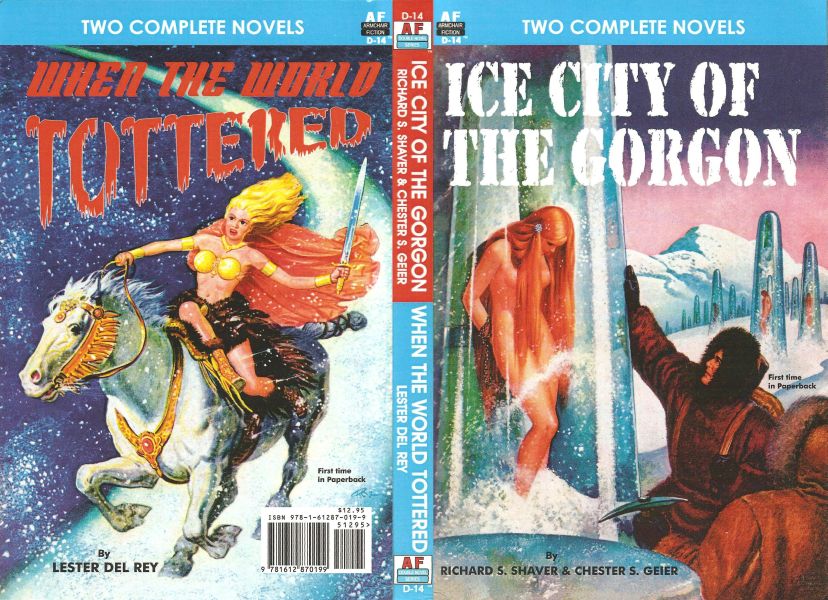

[Earlier Armchair Fiction two-fer edition, Valkyrie on Bifrost art by Robert Gibson Jones. Note the odd choice of pairing with Richard Shaver (go look up The Shaver Mystery ... which could have something to do with the Svartalfar, trolls, or huldrafolk, if one applies the lens of Norse Lore to Shaver's cthonic encounters).]
While Del Rey gives protagonist Leif a lot of then-modern American common sense & know-how, we find fault with the idea that any 20th century man would be technologically more savvy than the Gods, especially given they're cited to be 50,000 years old in the story. That they would not advance, even with a very restrictive cultural adherence, stretches credulity.

On the other hand, there are some really creative additions to the mythology that add to & fill in some blanks:

• That the Valkyries used an Alfheim magic to breathe an "elf seed", or regenerative flesh, into their chosen fallen, which is then drawn out to regenerate the hero whole back in Asgard. The new "elf flesh" then allows them to fight, die, and be reassembled at battle practice day's end.

• Freya's falcon cloak is in origin elf-made (perhaps given her brother's rulership of Alfheim?).

• Thor's hammer Mjölnir has magnetic properties which allows it to disarm others if it passes by an enemy's metal weapon. (*Yoink*!)

• Decades before the Marvel Film's "Thor" & "Thor: The Dark World" adaptations, Bifrost is not only a dimensional connector to earth/Midgard, but to all the Nine Worlds.

These extrapolations show Del Rey did a fair amount of thinking and his Edda homework. While there are some mistakes, reassignments of lore roles, and willful omissions to skip lengthy background explanations for the novella format, Del Rey garnishes his text with some lesser-used epithetical Gods' names, place references, and details that would make Snorri Sturluson proud.


[Avalon 1959 hardback cover art by Emsh. Note the misspelling of Del Rey's surname.]

In Del Rey's 1950s Atom Age, technology & the modernist future were ideals to be pursued, the new secular science replacing the old religious beliefs, and here he uses the Gods as a foil for that moral: Some traditions need to be re-examined if they stop a more useful progress. Yes, that's totally unfair to retroactively impose that ideal on the Norse Gods, especially since they inspired cultures that invented seafaring & navigational innovations to travel the world over, themselves bore the first smart weapons (i.e Gungnir, Mjölnir, & Sumarbranderinto battle, and created fish nets. But again Del Rey presents the Gods as nearly frozen in their personas & ways, so only in the context of his book can he get away with it.

Despite this then-contemporary misapplication, Del Rey's Day of the Giants is a fun read, his imaginative addenda to the lore is inspired, and seeing the details of the story NorsePlay'd out in the fateful tale of Ragnarök is rather worth it.


#     #     #

While a mostly happy bookstore fixture for over two decades, Guillermo Maytorena IV is currently willing to entertain your serious proposals for employment as a literary/cinema critic, goth journalist, castellan, airship pilot/crewperson, investigative mythologist, or assisting in a craft brewery. Should you be connected to any of the above or equally interesting endeavours, do contact him via LinkedIn or G+.

Tuesday, March 15, 2016

The Norse Gods Remixed.

The hard truth is that at the end of the post-conversion night, what we mostly have left of the Norse Gods are the Eddas.

And the fact is you want more NorsePlay.

We know from the Eddas' passing references there were tons more stories. And from within an oral tradition, all these tales were surely told & retold in many differing versions with emphasis placed or displaced depending on the audiences' points of interest or the skald's creative leanings. So when Norse Lore believers/followers/fans get bent that so-and-so told it "wrong" or added/subtracted things, there's an ancient & liberal precedent being celebrated with these differences.

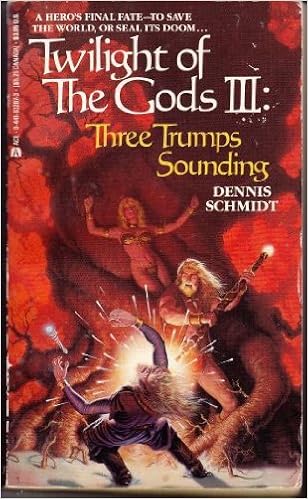
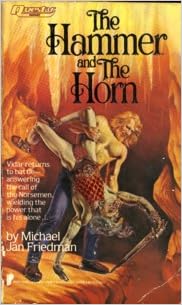
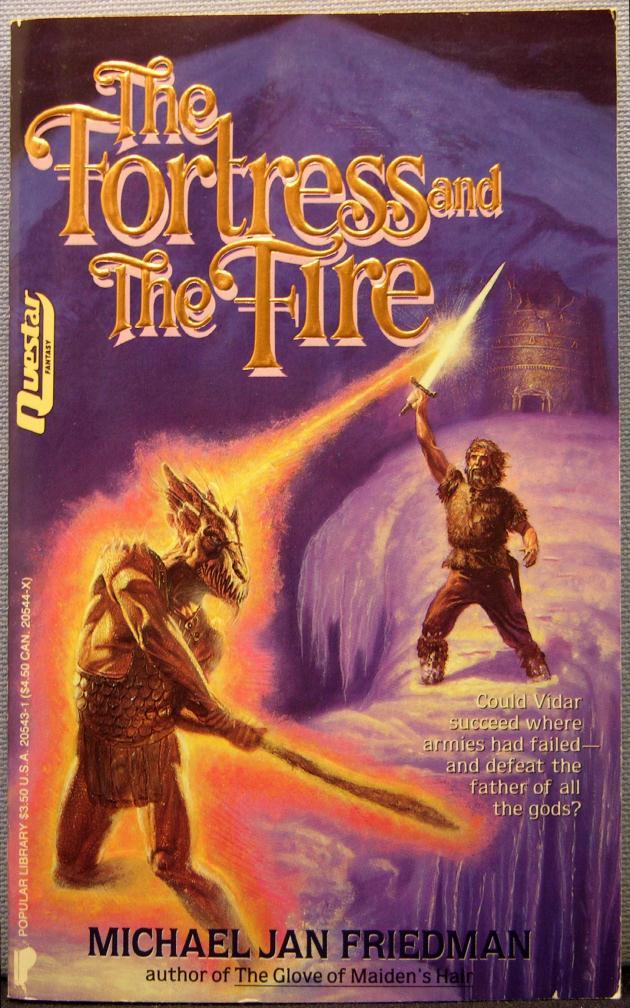
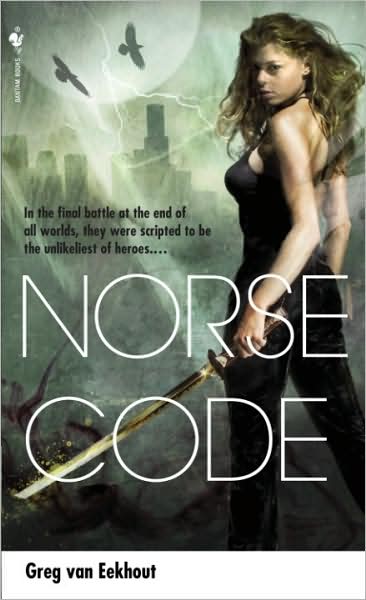
In this vein of expansive storytelling license, there's obviously Marvel's 1962 to now superhero take, but during that period Norse lore has been remixed by other daring authors, which we will survey here: Dennis Schmidt's Twilight of the Gods (1985-1987) trilogy as prequel/re-interpretive, and Michael Jan Friedman's Vidar Trilogy (1985-1988) as sequel (all pre-Neil Gaiman's American Gods [2001] & Odd and the Frost Giants [2008]), and well in advance of some conventions of Marvel and internet Rule 63 by decades. A post-Gaiman/Marvel selection also worthy of mention is Greg Van Eekout's stand-alone novel, Norse Code (2009). The first we'll review in detail, while the last two we'll briefly encapsulate.

Twilight of the Gods:


[Borr versus Surt!]
[Voden at Mimir's Well!]


[Unlike the other two, this cover art has nothing to do with the book.]


In a time of legend a la Robert E. Howard's Conan, where all ancient civilizations abide, so the Nine Norse Worlds instead get recast as other kingdoms and the world at large is itself known as Yggdrasil, the books' map going from northern Europe down to northern Africa, around an as-yet-to-be-flooded smaller Mediterranean. For example the desert dwelling Mesopotamians are the hot kingdom of Muspelheim, which makes for an interesting theory and opens one up to rethinking how strictly the stories we know & love are interpreted.

One theory about the Norse Gods is that instead they were prehistoric heroes who were then gradually euhemerized into divine beings, which is the bold step Schmidt takes with his version, but there's enough magic & supernature in his ancient world to go around.

The story starts with Borr going on an ambitious raid with Surt, and later follows Borr's son, Voden (the obvious Odin analog), on his wandering quest for knowledge, explaining along the way the stories behind his huge catalog of names, something any reader of the Eddas has been bound to wonder but never gotten an answer to. This name accruing thread is a clever & winning conceit.

Samples of interesting changes:

• Volund the Smith instead escapes from his captivity in the Jotun's northern kingdom down into Asaheim.

• The forest-dwelling Vanir are explored fully, their matriarchal society & rituals revealed. Lead by a queen Vanadis & counsel of nine Distingen priestesses, it seems their womanly superiority complex proactively causes friction with their northern plainsmen Aesir neighbors.

• Wicked deceiver Gullveig is not repeatedly speared by Aesir men and burned, but literally gang raped & thrown out, thus irreversibly "burned".

• The Mesopotamian underworld dragon Tiamat is likened to Norse Niflheim-dwelling Nidhogg, which shows how two different peoples can view what may have been ostensibly the same cosmological creature.

Schmidt is no religious studies slouch in these choices, having written an Eastern philosophy-based space opera as well, and integrates shamanic experiences, astral travel, and anthropology in his tellings. Legendary figures from other cultures also appear contemporaneously alongside Voden on his learning curve. Of note is Lao Tzu who wanders into the second book and becomes one of Voden's mentor figures. (And for you "purists" who think the Norse developed in a vacuum, think again -- they traveled the world, met Buddhists, got decorative arts & early shipbuilding from the Celts, and set up house in coastal Portugal.) And with all the dark Mesopotamian demon-summoning know-how, one questions if Schmidt had much exposure to Simon's version of The Necronomicon (1977) ... ?

Delightfully unexpected explanations for the myths we know are given, a joy of revealing the reasons behind the stories throughout all the books:
The water churned and splashed, sending a fine spray high into the air. If one crossed the ford at a certain time of day, when the sun was in the right position, a magnificent rainbow arched across the sky. ~ [p.55, on Bifrosti's Ford (the analog to Bifrost, the rainbow bridge to Asaheim.)]
There are moments where the philosophy floats on the very top of the story, but always as a pertinent aspect of world/character-building as opposed to a deep abstraction.

Included is a homage to Dune (1965) with highly detailed ritual knifefight in Jotun culture, a veiled but profound reference to William Carlos Williams' "The Red Wheelbarrow", and even a nod to the cult film Phantasm (1979)!

While The First Name & Groa's Other Eye seem more well paced with Schmidt re-visioning the murder of Ottar & the marriage of Thor, the stories seem more heavily piled on in the third book as the end approaches as though a checklist were referred to more in the last part of the author's process. One wonders if Schmidt had given himself the leisure of a fourth book whether this might've resulted in pacing those stories deserved, but this middling issue's a small one.

Schmidt's ambitious trilogy covers Voden's story from child to epic hero/magician/legend/apotheosis. At any time one wouldn't look twice at these books which appear just like any other pulp paperback gathering dust to be thrown out for new stock at a used bookstore, but we implore you that if you are a fan of Norse Mythology and fantasy in general, these long-hidden gems should be rescued and added to your library's treasure hoard.

Vidar Trilogy:


Michael Jan Friedman fearlessly remixes the Norse Lore by writing a sequel to the story long after the Eddas end. Odin's son, Vidar, survives Ragnarök and reacts to the war to end all wars by leaving the Aesir behind for a more creative & peaceful life on Midgard. We find our god of vengeance, now inconceivably old but still eternally young, making & selling sculpture as a bohemian artist in NYC. Of course, his past comes back to slowly but surely interfere with his new life.

As things unfold, we discover that Vidar spent much of his intervening lifetimes as a skald, and the narrative is interspersed with flashbacks that show the "true" versions of the great events of Norse legend he remembers from actually being there, versus the ones we got in diluted & altered form told by others, and these variants prove interesting, revealing the gods as different from the ones we know ... .

There are shades of Roger Zelazny's The Chronicles of Amber (1970–1991) in the Aesir, which adds an interfamilial complexity worth discovering.

Norse Code:


[Yes, a smart neo-valkyrie would select a katana.]
Greg van Eekhout's one-novel take on Norse lore finds our present world in strange days: political unrest, extremely weird weather, and the evident erosion of society itself. But the covert NorseCODE genome project knows better, and valkyrie Katy Castillo secretly finds & gathers the descendants of Odin for recruitment into the Aesir's final army that will hopefully save us all.

Along the way she finds wayward god Hermod, now a sort of vagrant wanderer L.A. dude who she enlists to help her go off the reservation and find out what's happened to her sister. There's a modern black humour reminiscent of wry Scandinavian sensibilities, while prophetic world doom quickly races them to the book's very rewarding end.


Unlike the lately released Rick Riordan's Magnus Chase and the Gods of Asgard or the less developed The Blackwell Pages trilogy by Armstrong & Marr, both for the lucrative young adult market, the above selections don't go for a shallow modern adolescent commentary, but celebrate & admire the original material while building soaring structures with newfound aspects on top of the Eddaic foundations.

This Norseplay shows the unshakeable constitution of these influential stories, their polyvalent nature, and the timeless endurance of the Gods.


#   #   # 


While a mostly happy bookstore fixture for over two decades, Guillermo Maytorena IV is currently willing to entertain your serious proposals for employment as a literary/cinema critic, goth journalist, castellan, airship pilot/crewperson, investigative mythologist, or assisting in a craft brewery. Should you be connected to any of the above or equally interesting endeavours, do contact him via LinkedIn or G+.

Tuesday, November 17, 2015

Chasing Magnus through the Norse Lore.

The unwritten criticism of young adult offerings (and it's not a genre, it's a market) is that none ever seem to pass the bar of its progenitor J.K. Rowling -- all else that follows Harry Potter's been derivative. Nor have they been able to strike such a grand balance between character & world-building as Rowling.

That bar still remains unapproached by Rick Riordan's latest trilogy series launch, Magnus Chase and the Gods of Asgard: The Sword of Summer, though you'd think with the richness of Norse Lore to draw from it might surpass the young wizard, but Magnus makes for a fun read.

Much like Riordan's Percy Jackson series, our titular protagonist has a mystery daddy, is a streetwise kid, has an important prophecy at age 16 event to propel their plot, and much internal thought reactions of sophomoric adolescent "smartness" in their texts for the teen reader & young-at-heart to identify with.

And our newly chosen hero & his varied party of gifted friends must accomplish a quest by a deadline for a lost object. Since Homer, or Tolkien, however, we never tire of this story's formula.

In contemporary fantasies our modern interpolations on ancient legends are where the humour's supposed to come from. Would today's modern man appreciate Valhalla? Maybe if it were turned into a hotel is Riordan's answer. And the pop culture references are meant to give enough perspective for a young & modern audience to see Riordan's pushing forward of the long-hidden denizens of the Nine Norse Worlds, but push the results of this technique ten years on and it might read more dated than classic. 

Where Magnus really shines is when it provides other unthought of specifics & fill-ins, such as an actual descriptor of the taste of Mimir's well of knowledge, or elaborating on the current results of Freya's bartering with the dwarven Brisings, adding to the list of "paradox ingredients", or the unique physics of Jotunheim.
"The smell of the giants' body odor -- a combination of wet clay and sour meat ..." [p.388]
These new imaginings give the reader some nice mythological extras.

Another cool hard copy reader extra (because real books will always rule!) is that depending where you buy your copy, you actually get something extra: If off a pallet at CostCo, it's a bookmark. If from the shelf of Barnes & Noble, it's a small pamphlet guide to the Norse Gods. If from the bestseller rack at Target, it's a mini-poster of the Nine Worlds. And there's even a limited edition slipcased version if you order yours from Amazon UK.

Points in the plot borrow many episodes in Norse Lore but instead place Magnus & Co within them, so if you've read the original stories you'll be the inside reader:


"We met at that party at Bilskirner -- the one where you were playing tug-of-war with Loki?" 
"Oh ... ." [He] shook his horns. "Yes. That was embarrassing." [p.343]

... but not so surprised, and if you haven't read the stories the narrative will be new ... but weirdly seeming a bit forced. There's a familiar eagle dragging a character, some fishing for a large sea monster, a deception by giantesses, et cetera. Some of the comparative situations are funny, while others fall flat from trying too hard.

For Rick Riordan fans, Annabeth Chase from Percy Jackson cameos, turning out to be Magnus' cousin. This also implies a shared universe which might lead to a conflict between the pantheons ... ? Maybe even a duel between Percy & Magnus? (A Red Gold on Magnus! Sumarbrander totally breaks Riptide.)


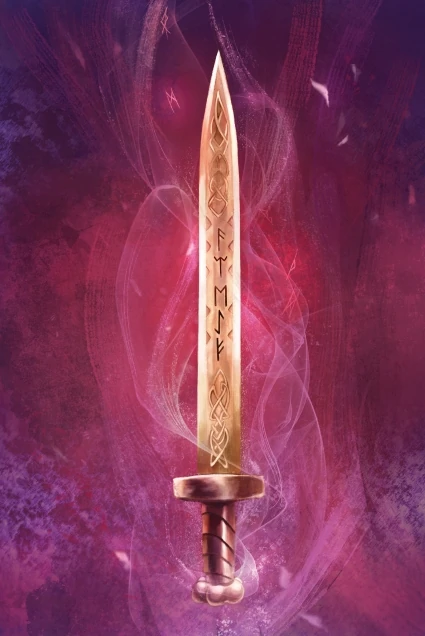
[Sumarbrander!] 
While in the Lore the monsters are universal forces of entropy & destruction, in Riordan's worlds they are external manifestations of our fears & anxieties amplified, reflections of fault & weakness & regret, giving the characters' encounters with them a more crushingly personal aspect.

And in an interesting setting decision, Texan Rick Riordan celebrates his own Boston transplantation by imbuing Beantown with a close connection to Yggdrasil, the World Tree, thus making the northeastern city a crossroads to getting from Midgard, our world, to the other Nine Worlds.

In contrast to the Lore, sometimes the book puts itself at odds with the lessons in the original stories. Odin teaches that knowledge sometimes requires levels of personal & impersonal sacrifice, but Magnus questions this and frequently whines & opines differently as he proceeds on his quest.

We would adore it if Magnus Chase were to give kids & adults new to the epic accounts of the Norse Gods the same wonder & fascination that we got from D'Aulaires' Norse Gods & Giants (which really still stands as the best [even if Magnus currently outsells it on Amazon]) when we were growing up, and enough to direct them to later go read the Eddas where they came from. In all, Riordan, previously a teacher by trade, has written an entertaining embroidery of the lore that hopefully opens this door to Asgardian narratives.

Part two of the Magnus Chase trilogy, The Hammer of Thor, is scheduled for release October 4th, 2016. We can only hold out a reader's hope that this upcoming literary Mjölnir can finally smash Potter's wand.


#  #  #

While a mostly happy bookstore fixture for over two decades, Guillermo Maytorena IV is currently willing to entertain your serious proposals for employment as a literary/cinema critic, goth journalist, castellan, airship pilot/crewperson, investigative mythologist, or assisting in a craft brewery. Should you be connected to any of the above or equally interesting endeavours, do contact him.

Friday, January 3, 2014

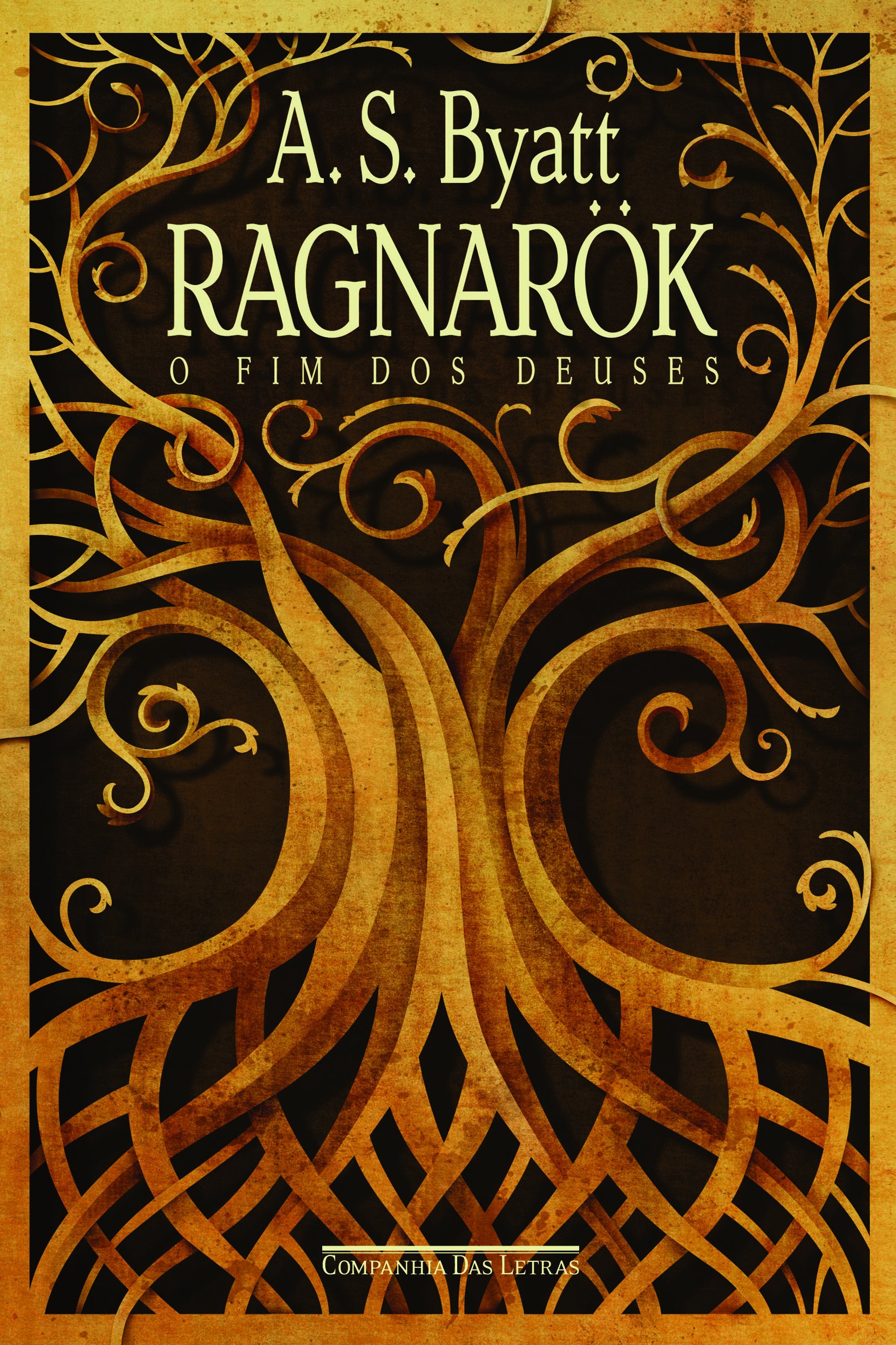
Byatt's Ragnarök: re-purposing mythology.

After reading trendy Eggers' underwhelming recent essay on the D'Aulaires' childhood classic Norse Gods & Giants (which one already knows is wondrous all-ages magic without his stamp of uninsightful approval), running across celebrated A.S. Byatt doing her take on Norse lore was an offering Nine Worlds better.

Known for one of the most refined epistolary novels, the Booker Prize winning Possession (1990), which will rip your heart out and make it pump tears of saddest sad sadness, one can only imagine the Wagnerian angst & pathos such a talent could lend to the verses of the Gods. Yet the tender Possession and the Icelandic skald Snorri Sturluson's mythopoeic collection are also worlds away from each other, and the gap shows at times.


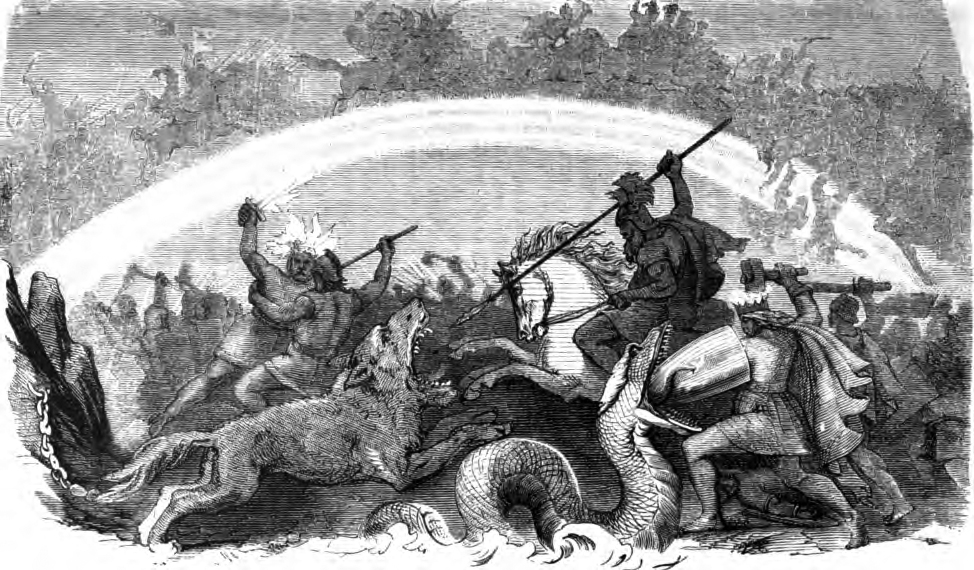
[Friedrich Wilhelm Heine's "Kampf der untergehenden Götter" (1882).]
In Ragnarok: The End of the Gods (2011), Byatt brings her own modern insights into the built-in eschatology of the Northmen. While she's hardly the first one to do this academically or creatively, having her mind turned toward a personal interpretation gives one surprising perspective on Asgard and its gods. While many dismiss Loki as an antagonist for antagonism's sake (or conversely worship him [semi- or even non-apologetically] as a divine medium of difficult change & transformation), Byatt presents Loki less as a god of mischief and more as an explorer of the patterns found in chaos theory, an outsider by nature of his extremely inquisitive, and possibly superior, mind. This also lets us to see how the higher functioning Odin continues to allow his both disruptive but useful presence as a blood brother and travel companion, as Odin may have more in common with Loki on intellectual levels than the others of his heavenly house. Byatt also puts forward the theory that Loki is part of the original triumvirate who creates man & woman from an ash & elder tree, and specifically is able to contribute to the miracle of mankind by transmuting the tree's sap into blood, making him far more integral to humanity's story. She also explains that Odin ascends to be the ruler over his two man-making peers as he sacrifices himself, his eye, and identity, for ecstatic knowledge.

Byatt also a offers a psychological take on the monstrous wolves who chase the sun & moon across the sky as "wolves of the mind", an ever-present built-in idea of the intellect's potential for self-destruction manifest as the ravening creatures that threaten to swallow the sources of illumination in ourselves & the world. Plus she posits that if the wolves weren't there as the clockwork that drives day into night and night into day, there would be no demarcations of time or season without them, and no universal/internal motivators to keep ourselves achieving instead of descending into darkness or lassitude.


Framing all this re-appropriation of the lore is Byatt herself presented as "the thin, pale child", a nameless girl displaced into the countryside by the Blitzkrieg of World War II (much like a Pevensie of Narnia), with naught much else but a copy of a Norse mythology book to give her some strange & fantastic comfort. The child's voice is hardly that of a child, but of our 75-year-old authoress looking back at herself, and at the Heathen legends that fascinated her far more than the compulsory trips to monotheistic church or a secular schoolhouse.

Outside the lines, Ragnarok succeeds as a commentary of amazement with a wonderfilled personal embellishment, an ambitious filling out of the cosmology. Most inventive is Randrasill, the undersea skeletal analogue to Yggdrasil, her construct equally full of life, giving the reader a deepwater survey of the aquatic legion that surrounds Midgard. Exiled into this world by Odin, Byatt also performs another first by presenting a POV from world serpent Jormungandr, and adding scenes of Loki's fathership in raising his daughter from simple sea snake into an ominous ouroboros.

Less than these two inventions, Byatt lends her explanations to the Baldur story. One always questions that if Baldur's death means the worlds' end, why would the gods make a game of throwing potentially deadly things at him? Yet once the gods come up with it, "Hit the Baldur" isn't just an afternoon novelty but the best-game-ever invented, and they find they can't stop from playing. One also questions why if Frigga went through the trouble of ranging the whole of the Nine Worlds to obtain a promise from everything animate & inanimate, how did mistletoe get neglected? We find that mistletoe appeared in the world just after this infinite contract was closed, that it was still childlike and "too young to make a promise", leaving its innocence open for Loki's manipulation into a weapon.

When Ragnarok does unfold, another in-battle perspective Byatt presents is that Thor doesn't realize he's been poisoned until it's too late, turning to brag to the Aesir that he bested his nemesis and lived, only to fall to the venom on his ninth & very last step.

[Marvel Thor is not amused.]
Vocabulary of note is the repeated use of the fatalistic word "ineluctable", and the admirable neologism "ur-book". ("Ur-book"! Wow!)

Conclusions? Ultimately there's no payoff with the Nazi threat, or the conflict inherent in her Germanic heritage, or a ratification of a Heathen worldview, so the framework for the storytelling's inconclusive as it never comes back around to the pale child who is Byatt in any satisfying way. There could've been a sort of Teutons versus Angles call-forward, an examination of the "wolves" that drive the conflict of war, like natio/tribal fascism, and comment on the necessity of preparation for war, but none of these ideas are ever truly exercised.

Byatt uses parts of Ragnarok as an allegory on our inability to save the world, to change our story, and in her afterword goes so far as to place her interpretation's concern for the world as an ecological one, which is a thoroughly modern use. The disconnect here's evident: Byatt's contemporary purpose is not the timeless purpose of the lore. Not to say that the Norse creation/apocalypse doesn't contain everything (oh it surely does), but the tenuousness of physical existence more reflects man's barely sustainable grasp in a world of forces that defies his daily living with an unrelenting ice & harsh frost that deny him resources and its impact on him, as opposed to his impact on it. If one can bypass this mis-inversion, there's alot of other grand exploration to be had in Byatt's otherwise earnest rendition the Norse lore. Like in Possession, there's a strong lifelong and even more cosmic love here that cannot be denied.

#   #   # 

While a mostly happy bookstore fixture for over two decades, Guillermo Maytorena IV is currently willing to entertain your serious proposals for employment as a literary/cinema critic, goth journalist, castellan, airship pilot/crewperson, investigative mythologist, or assisting in a craft brewery. Should you be connected to any of the above or equally interesting endeavours, do contact him.