Search

Showing posts with label ur-book. Show all posts

Friday, March 17, 2017

NorsePlay: Neil Gaiman's "Norse Mythology".

Neil Gaiman faced the daunting task to adapt the narrative holy of the holies, the ur-book stories, the most ancient tales known to man from which all other tales have since flowed from: Norse Mythology.

As we told a childhood friend of Neil's last month, Neil is a fearless writer, that before Neil there wasn't a great movement in the fantasy genre to use the Gods as actual intimate first & close third-person protagonists.


[Neil Gaiman being fearless!]
We look back at his record for this daring talent with reading pleasure: The Sandman (his breakout World Fantasy Award-winning graphic novel series expanding the being of Greek deity Morpheus), American Gods (heavily featuring Gods from various pantheons), and Odd & the Frost Giants (a NorsePlay story for children of all ages). And now, in a tribute to pay back what originally inspired him, Gaiman offers us his version of Norse Mythology.

In his introduction, Neil points out and mourns the loss of many stories in the Norse Lore, with only hints of more left behind in epithets and kennings:


I wish I could retell the tales of Eir, because she was the doctor of the gods, of Lofn, the comforter, who was a Norse goddess of marriages, or of Sjofn, a goddess of love. Not to mention Vor, goddess of wisdom. I can imagine stories, but I cannot tell their tales. (p.14)

You big tease, Mr. Gaiman, as we're pretty sure you could draft some. (And go check out "The Almighty Johnsons" for an interesting take on these goddesses.)


One can't help but hear Gaiman's comfortable English accent while reading. (If you're unfamiliar, listen to this.) Some authors make a total hash of reading their own work (talking to you, departed Douglas Adams), but the words here just rise off the page as though you're listening by a campfire. 


The bar for comparison will always be D'Aulaires' Norse Gods & Giants, but Gaiman instead grew up with Roger Lancelyn Green's Myths of the Norsemen. This early inspiration aside, he sources Snorri Sturluson, the Poetic Edda, and Rudolf Simek's Dictionary of Norse Mythology for his current retelling.


[Fenrir-fraught German edition cover.]
There's an open-endedness to the Norse Lore which allows the teller to detail in the blanks as they see fit. Everyone takes the opportunity to do so, and in this Gaiman is no different. Just when you thought you'd heard all the names for the Gods, he comes up with some original epithets, which is a skaldic achievement.

Charming anachronisms, born of Gaiman's penchant for contemporary urban fantasy (i.e. Neverwhere), make their way into his version of the Eddaic material. For instance, the giant that survives Ymir's flood of lifeblood does so by "clamoring onto a wooden box" (p.32), and smithy dwarf Brokk threatens Loki with converting his head into "A thinking machine (...) Or an inkwell." (p.55) The fact that these modern day items can flow backward and find a place inside these stories only reinforces the Norse Lore's timeless essence.


Other interesting additions and modifications in Gaiman's version include: the cosmic giant Ymir being made neither sex yet hermaphrodite, the detail of runes inscribed on the sides of Utgardaloki's bottomless challenge horn, the rationalization of Odin, Vili, & Ve wanting to create better worlds to live in & thus sanctioning the necessary sacrifice of Ymir to provide realm-building materials to do so, the prick of "Baldur's bell-like laughter...", a new character of Thyrm's conniving sister at Thor's marriage, and Mjölnir winning the the dwarven crafting contest because of its ability to protect, as Gaiman emphasizes that value far above the other entries.


Gaiman also specifically assigns the Vanir's Frey & Freya with the creation of Kvasir, which dovetails nicely into their role as both generative/creative gods and as the members of the post-war tribal exchange.


As the book continues, one can't help but notice Gaiman's enjoyment of writing Loki as a foil for events, especially seen in his extended embellishment of Loki's seduction of the giant's draft horse into something rather sensual.


"The Mead of Poets" is a brilliant standout. The dwarves who kill Kvasir are recast from spiteful miscreants into alchemists, which makes more sense for the murder's resultant beverage. And Bolverkr's underhanded wooing of Gunnlod's done as well as any modern lothario running game on a girl on any given club night.

"Hymir and Thor's Fishing Expedition" partly gets retold as a bad stepfather story, as Tyr's giantess mother marries the abusive & inhospitable Hymir, and we get a taste of Tyr's oppressive early home life.


Hel's half-dead side is descibed as looking into the "pale eye of a corpse" (the exact phrase Gaiman re-uses later for midwinter's brief and distant sun). Gaiman's previous empathetic personification of Death in Sandman may have been partly influenced by her Gothic-forbearer Hel:

"I am only myself, Hel, daughter of Angerboda and of Loki," she said. "And I like the dead best of all. They are simple things, and they talk to me with respect. The living look at me with revulsion."
One can't help but admire Hel's forthright manner, and despite the horror of her condition, she wins us with her self-acceptance, and also wins Odin when he gives her a fitting place in his cosmic scheme of things.

Gaiman reorders events to make more narrative sense. Odin raises the long dead wise woman völva only once, far later in the stories after Balder experiences his plague of nightmares. Gaiman also takes the liberty of making the völva Loki's lover & monster mother jötunness Angrboda, which makes her belligerent & doom-filled revelations to Odin more motivated. This shuffling of prophecy toward the end of things gives the reader a feeling that Ragnarök's too late to stop by the time Odin hears of it, which eliminates the usual planning versus destiny questions of why can't it be avoided if the Gods know about it from so early on in the stories' throughline.


[Hungarian edition.]
Like in Sandman, and in his introduction, Gaiman falls prey to the common slanderous reduction of Thor to a box of hammers ... which ignores Thor's verbally deft outwitting of dwaven Alvíss (actually meaning "All-Wise") to save his daughter Thrud from his amorous attentions, and Gaiman omits this story in his collection. 

A huge deviation in "The Story of Gerd and Frey" is that Gerd's refusal of Frey's proposal is completely skipped. One wonders if the coercion aspect was found to be distasteful by the author, but that's negated anyhow for most modern audiences by her finding mutual happiness with Frey at the end. He is a God of love after all, and being selected by love itself for marriage would be the ultimate compliment.

A serious missed-opportunity occurs in "The Last Days of Loki" when the "Lokasenna" usually takes place. During this episode Loki calls out all the Gods on their transgressions and shortcomings in an attempt to show them they're as mischievous as he is and hypocritical to boot (which is false since Loki's brand of mischief also harms everyone and is born of a darker motivation). Unlike Gaiman's previous writerly use of Loki, he skips the potential of this famous verbal tennis match entirely, which we found disappointing.


[Domestic cover with nordic landscaping.]
During "Ragnarok: The Final Destiny of the Gods", there's a dying exchange between Heimdall & Loki, and a gorgeous post-Ragnarok ending that movingly capstones the book.

Bottom-line: Does Gaiman significantly improve the telling? No, but his telling is respectful, adorned with thoughtful things only he would do, crafted with the fuzzy edges of myth gathered & woven into smoother narratives, poetic yet accessible, and, in many passages, beautiful & wondrous. In that meritorious achievement, Gaiman fulfills the role of that Green version he grew up with, and this new version will be the lens through which the current generation first encounters the All-Father, the Trickster, and the Thunderer. Snorri would be proud.


#      #      #

While a mostly happy bookstore fixture for over two decades, Guillermo Maytorena IV is currently willing to entertain your serious proposals for employment as a literary/cinema critic, goth journalist, castellan, airship pilot/crewperson, investigative mythologist, or assisting in a craft brewery. Should you be connected to any of the above or equally interesting endeavours, do contact him viaLinkedIn or G+.

Friday, January 3, 2014

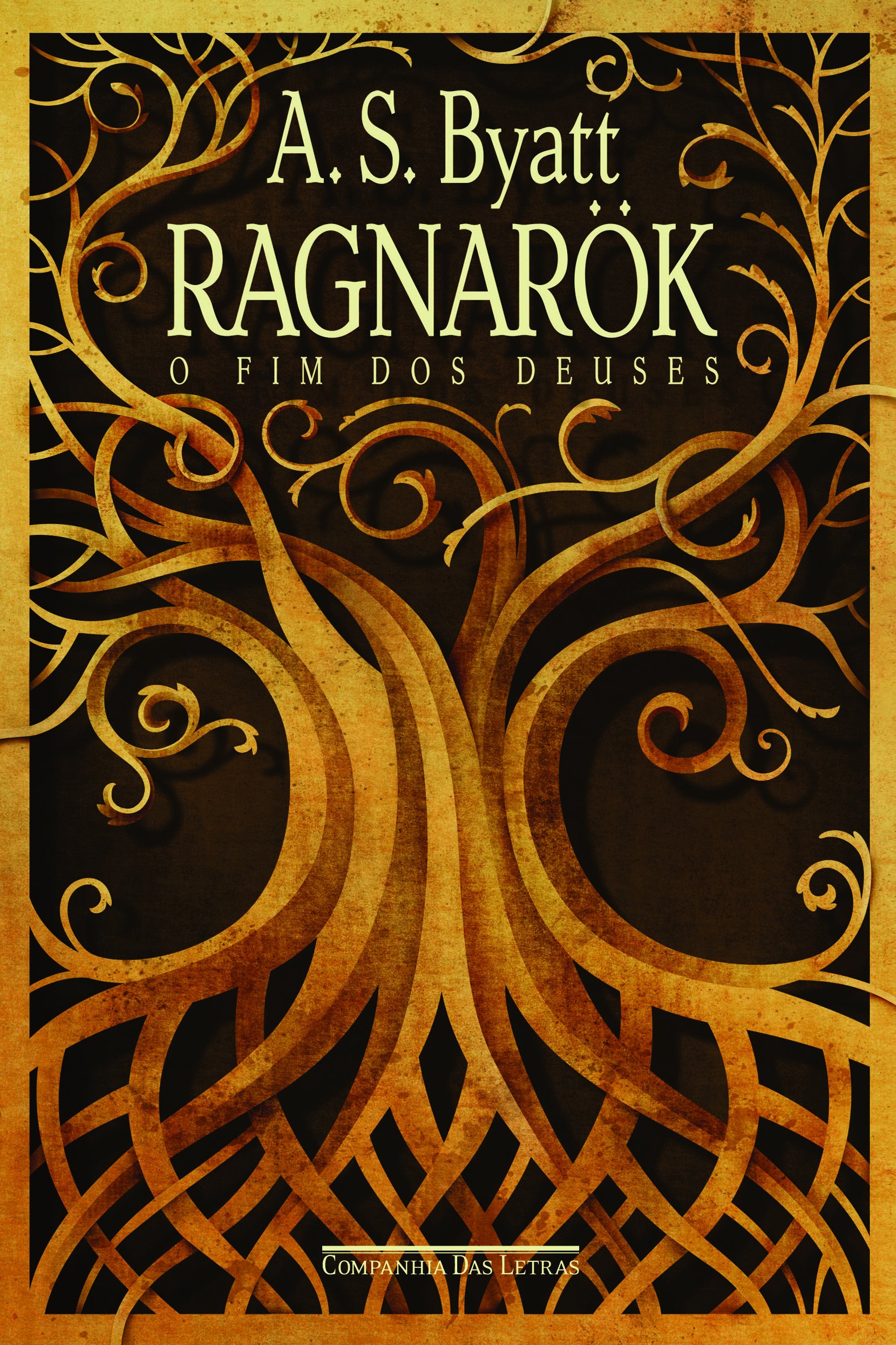
Byatt's Ragnarök: re-purposing mythology.

After reading trendy Eggers' underwhelming recent essay on the D'Aulaires' childhood classic Norse Gods & Giants (which one already knows is wondrous all-ages magic without his stamp of uninsightful approval), running across celebrated A.S. Byatt doing her take on Norse lore was an offering Nine Worlds better.

Known for one of the most refined epistolary novels, the Booker Prize winning Possession (1990), which will rip your heart out and make it pump tears of saddest sad sadness, one can only imagine the Wagnerian angst & pathos such a talent could lend to the verses of the Gods. Yet the tender Possession and the Icelandic skald Snorri Sturluson's mythopoeic collection are also worlds away from each other, and the gap shows at times.


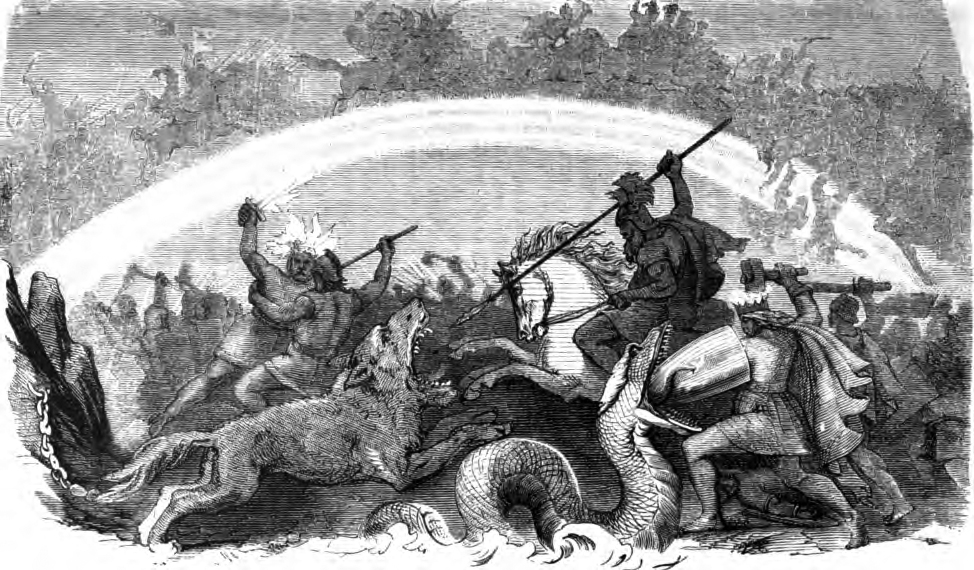
[Friedrich Wilhelm Heine's "Kampf der untergehenden Götter" (1882).]
In Ragnarok: The End of the Gods (2011), Byatt brings her own modern insights into the built-in eschatology of the Northmen. While she's hardly the first one to do this academically or creatively, having her mind turned toward a personal interpretation gives one surprising perspective on Asgard and its gods. While many dismiss Loki as an antagonist for antagonism's sake (or conversely worship him [semi- or even non-apologetically] as a divine medium of difficult change & transformation), Byatt presents Loki less as a god of mischief and more as an explorer of the patterns found in chaos theory, an outsider by nature of his extremely inquisitive, and possibly superior, mind. This also lets us to see how the higher functioning Odin continues to allow his both disruptive but useful presence as a blood brother and travel companion, as Odin may have more in common with Loki on intellectual levels than the others of his heavenly house. Byatt also puts forward the theory that Loki is part of the original triumvirate who creates man & woman from an ash & elder tree, and specifically is able to contribute to the miracle of mankind by transmuting the tree's sap into blood, making him far more integral to humanity's story. She also explains that Odin ascends to be the ruler over his two man-making peers as he sacrifices himself, his eye, and identity, for ecstatic knowledge.

Byatt also a offers a psychological take on the monstrous wolves who chase the sun & moon across the sky as "wolves of the mind", an ever-present built-in idea of the intellect's potential for self-destruction manifest as the ravening creatures that threaten to swallow the sources of illumination in ourselves & the world. Plus she posits that if the wolves weren't there as the clockwork that drives day into night and night into day, there would be no demarcations of time or season without them, and no universal/internal motivators to keep ourselves achieving instead of descending into darkness or lassitude.


Framing all this re-appropriation of the lore is Byatt herself presented as "the thin, pale child", a nameless girl displaced into the countryside by the Blitzkrieg of World War II (much like a Pevensie of Narnia), with naught much else but a copy of a Norse mythology book to give her some strange & fantastic comfort. The child's voice is hardly that of a child, but of our 75-year-old authoress looking back at herself, and at the Heathen legends that fascinated her far more than the compulsory trips to monotheistic church or a secular schoolhouse.

Outside the lines, Ragnarok succeeds as a commentary of amazement with a wonderfilled personal embellishment, an ambitious filling out of the cosmology. Most inventive is Randrasill, the undersea skeletal analogue to Yggdrasil, her construct equally full of life, giving the reader a deepwater survey of the aquatic legion that surrounds Midgard. Exiled into this world by Odin, Byatt also performs another first by presenting a POV from world serpent Jormungandr, and adding scenes of Loki's fathership in raising his daughter from simple sea snake into an ominous ouroboros.

Less than these two inventions, Byatt lends her explanations to the Baldur story. One always questions that if Baldur's death means the worlds' end, why would the gods make a game of throwing potentially deadly things at him? Yet once the gods come up with it, "Hit the Baldur" isn't just an afternoon novelty but the best-game-ever invented, and they find they can't stop from playing. One also questions why if Frigga went through the trouble of ranging the whole of the Nine Worlds to obtain a promise from everything animate & inanimate, how did mistletoe get neglected? We find that mistletoe appeared in the world just after this infinite contract was closed, that it was still childlike and "too young to make a promise", leaving its innocence open for Loki's manipulation into a weapon.

When Ragnarok does unfold, another in-battle perspective Byatt presents is that Thor doesn't realize he's been poisoned until it's too late, turning to brag to the Aesir that he bested his nemesis and lived, only to fall to the venom on his ninth & very last step.

[Marvel Thor is not amused.]
Vocabulary of note is the repeated use of the fatalistic word "ineluctable", and the admirable neologism "ur-book". ("Ur-book"! Wow!)

Conclusions? Ultimately there's no payoff with the Nazi threat, or the conflict inherent in her Germanic heritage, or a ratification of a Heathen worldview, so the framework for the storytelling's inconclusive as it never comes back around to the pale child who is Byatt in any satisfying way. There could've been a sort of Teutons versus Angles call-forward, an examination of the "wolves" that drive the conflict of war, like natio/tribal fascism, and comment on the necessity of preparation for war, but none of these ideas are ever truly exercised.

Byatt uses parts of Ragnarok as an allegory on our inability to save the world, to change our story, and in her afterword goes so far as to place her interpretation's concern for the world as an ecological one, which is a thoroughly modern use. The disconnect here's evident: Byatt's contemporary purpose is not the timeless purpose of the lore. Not to say that the Norse creation/apocalypse doesn't contain everything (oh it surely does), but the tenuousness of physical existence more reflects man's barely sustainable grasp in a world of forces that defies his daily living with an unrelenting ice & harsh frost that deny him resources and its impact on him, as opposed to his impact on it. If one can bypass this mis-inversion, there's alot of other grand exploration to be had in Byatt's otherwise earnest rendition the Norse lore. Like in Possession, there's a strong lifelong and even more cosmic love here that cannot be denied.

#   #   # 

While a mostly happy bookstore fixture for over two decades, Guillermo Maytorena IV is currently willing to entertain your serious proposals for employment as a literary/cinema critic, goth journalist, castellan, airship pilot/crewperson, investigative mythologist, or assisting in a craft brewery. Should you be connected to any of the above or equally interesting endeavours, do contact him.