Search

Friday, April 29, 2016

Dumézil investigates the Gods of the Ancient Northmen.

Georges Dumézil's Gods of the Ancient Northmen surpasses the academic into the realm of poetic & enlightening, like a good professor when he's got love behind his lecture. And of these eight chapters, some actually are taken from Dumézil's lectures.

Published in 1959, this post-doctoral thesis level work of comparative mythology shows French professor Dumézil's thoughtful expansion of the study of Norse lore from the mostly associative philology it was into a functionalist sociology, which invites easier comparisons with the Hindu gods and thus backtracks their migration to the Indo-European.
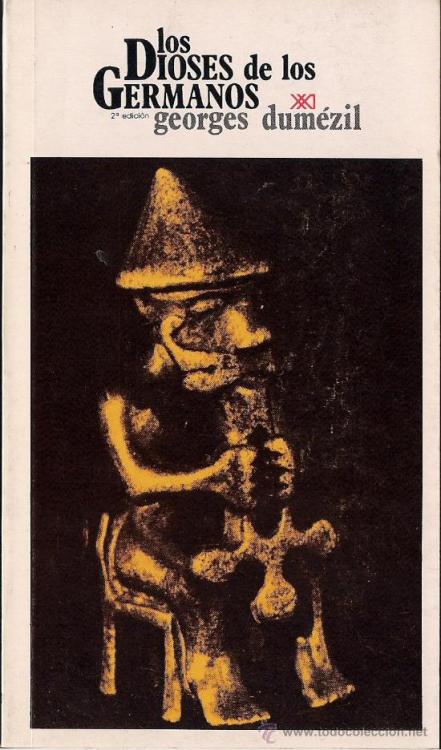


[Spanish edition cover featuring Icelandic Thor.]

Dumézil's trifunctional hypothesis posits that the functions of the gods reflect a society's factional roles, with Odin, Thor, & Frey being the major triumvirate and thus classifying that society's members into rulers, warriors, or farmers, respectively.

Also if modern Indian society is made up of castes, then Dumézil follows that this is a hold-over from Indo-European roles represented by the deities Varuṇa, Indra, & Nasatya, who also have similar functions as Odin, Thor, and Frey, and therefore correspond to those post-migration deities.

Supporting this association, Dumézil shows additional parallels between the tales of Kvasir (a being turned into the intoxicating drink of poetry) and the vedic Mada (a giant who's name means drunkenness), both importantly figuring in the end of a war between factions of the gods (Aesir versus Vanir & the Indian sky versus nature gods), and the Mahabharata's inter-familial struggle of Shakuni tricking Yudhishthira into exile compared to Loki's catspawing of Hodr to kill Baldur among the Aesir (which of course presages Ragnarök, and for the former, the Kurukshetra War).

The author also casts some grim light on the Vanir goddess Nerthus, who according to Roman historian Tacitus' Germania was in a veiled cart and given a procession to visit and bless all the towns before returning to her sacred island. Just before that return however, slaves who bathe the cart & see the goddess are drowned in her lake (!):

"From there comes a mysterious terror, the sacred ignorance of the nature of a secret that is seen only by those who are going to perish." (Tacitus, ch40)

Another reveal mentions the nail in Thor's head depicted in statues (p70), which we'd never run across until finding this illustration online:
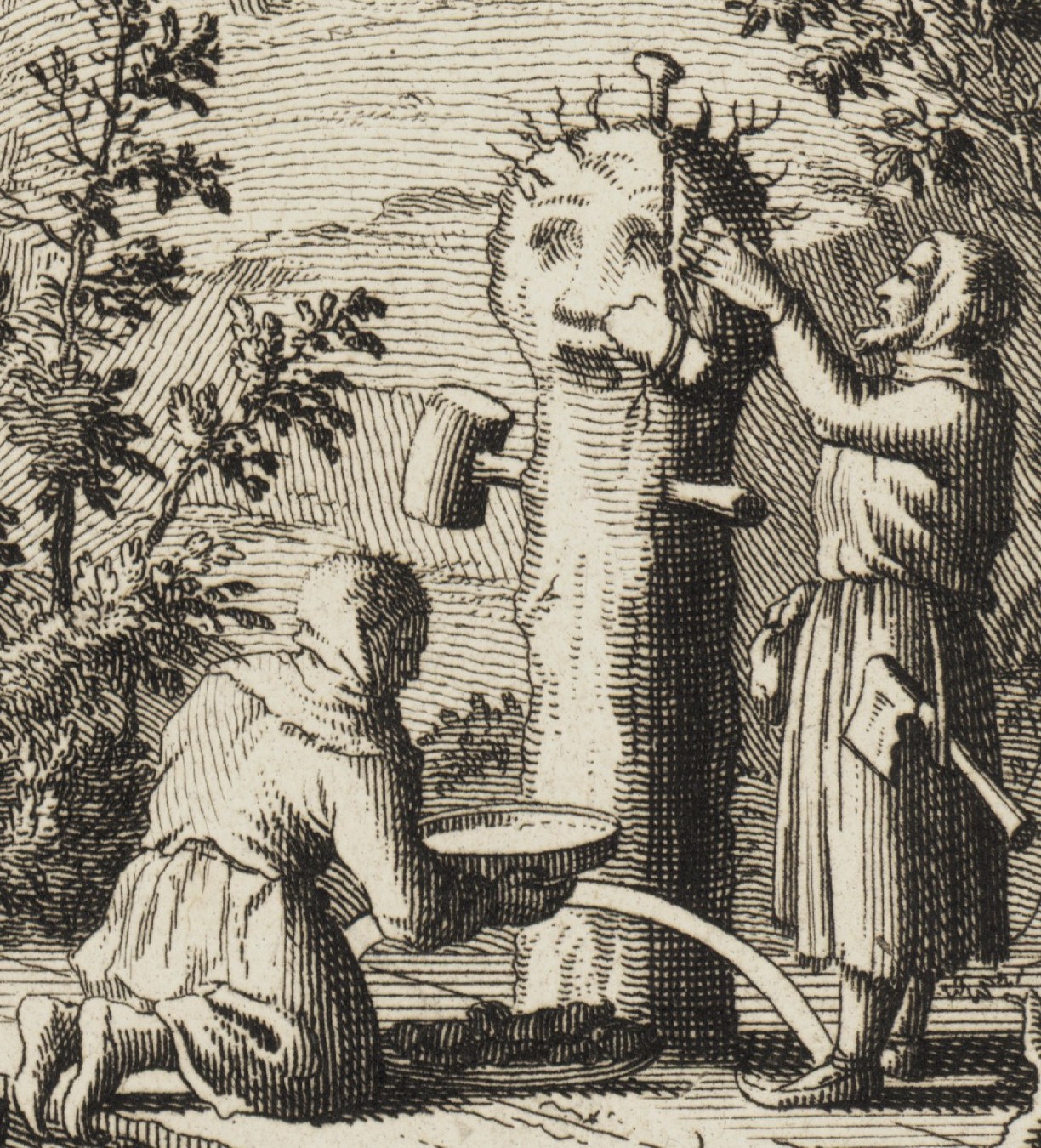

[God pole engraving of Sami storm deity Horagalles ("Thor-Man") with nail in his head hung with whetstone. By Bernard Picart, 1725.]

Dumézil likens the stuck hone from Thor's first formal duel to legendary Irish hero Cu Chulainn's hone-like shaped head "emanation" after his first battle, and would guess that there's a representation of a warrior's rite of passage in this striking similarity.


And Dumézil works out an impressive mental somersault into a what seems to be correct identities for Byggvir & Beyla, two mysterious companions to Frey passingly mentioned in the Lokasenna. From clues in retorts made by Loki, the former male is Barley, and the latter female is the Bee (this conclusion expanded in Dennis Schmidt's erudite & entertaining re-imagining of the Eddas, Twilight of the Gods), both appropriate offerings & personified associates of harvest god Frey.

Heimdall, a god with so many inexplicable epithets, also gets the acute eye of Dumézil's associative reasoning by figuring out that the "whitest of the gods" (compare to Baldur, "brightest of the gods") probably connects with another name for Freya: Mardoll (note the suffixes -dall & -doll), which means sea-light. Heimdall's sea origins come from his nine mothers, the waves, who are the nine daughters of the sea jotuns Ægir & Rán. Sailors say the ninth wave is the roughest, and therefore the most decisive of action, and that many cultures liken the foamy tops of waves to charging white animals. In the case of the Welsh and the sailors' saying, the first eight are ewes, but the strongest is the forceful ram, which gives Heimdall his godly connection with the ram, applicable to his last mother. This is but a few of the explorations Dumézil pulls together on this deity.

Parisian Georges Dumézil (1898-1986) could read Latin by age nine, served as an artilleryman in WWI, earned his doctorate in classics by comparing the Greek divine drink ambrosia with the Indian immortality drink amrita, taught in Istanbul, Uppsala, & France, achieved membership in the prestigious Académie Française, and through most of that time published many, many works on comparative mythology.

Flying in the face of the above curriculum vitae and after reading this study, we feel the tripartite theory is a simplification, an academic's need to place people in boxes using the roles of their major gods to do so. While this mirroring looks great on paper, societies have specialists (i.e. craftspeople, seers, clergy, merchants, scribes, et cetera) that do not fit in such cut & dried classifications. Yet without a time machine or further accounts one cannot discount Dumézil's trifunctional theory. We do note that in old Nordic societies the farmers were also the same warriors who went on viking raids, so while those functions were separate the same individuals did both, as per need or season. Despite this critic's disagreement with the core thesis, there's so much depth & perceptiveness that Dumézil has to teach that even the most hardcore of mythology mavens never knew of, which makes this book so worth learning from.

While there are bilingual side-by-side translations of Icelandic quotations to English, there are also many parts where German, Greek, Latin, French, and others are used but not translated, author & editor expecting their audience to know them. We should be flattered by this presumption, but instead find ourselves quite stymied, and suspect most monoglot readers will be too.

In sum Gods of the Ancient Northmen isn't so much a progression as it is a collection of papers & combined lectures, which leaves no great conclusion, but its amazing examinations can only make us scrutinize & broaden our search for answers.


[One wonders at what other insights could've been discerned if Georges Dumézil had a search engine for his library.]

The individual chapters & exploratory passages all contain great points that are provocative & illuminating. Dumézil's reasonings within Gods of the Ancient Northmen's an impressive thought exercise to get us to continue to think of our divinities in different ways in order to learn more about them -- an intellectual pursuit of insight Odin would totally approve of.

#  #  #

While a mostly happy bookstore fixture for over two decades, Guillermo Maytorena IV is currently willing to entertain your serious proposals for employment as a literary/cinema critic, goth journalist, castellan, airship pilot/crewperson, investigative mythologist, or assisting in a craft brewery. Should you be connected to any of the above or equally interesting endeavours, do contact him via LinkedIn or G+.

Saturday, April 9, 2016

The Speaker in the Darkness.

Out of the dark bedroom a voice that wasn't my wife's spoke:
"Cold ... chilly ... chilly."
I froze, wondering who was talking -- it was the dog!
Since then I've listened carefully every night for him to slip up and mutter something, anything, again ... .


#   #   #

While a mostly happy bookstore fixture for over two decades, Guillermo Maytorena IV is currently willing to entertain your serious proposals for employment as a literary/cinema critic, goth journalist, castellan, airship pilot/crewperson, investigative mythologist, or assisting in a craft brewery. Should you be connected to any of the above or equally interesting endeavours, do contact him.

Tuesday, March 15, 2016

The Norse Gods Remixed.

The hard truth is that at the end of the post-conversion night, what we mostly have left of the Norse Gods are the Eddas.

And the fact is you want more NorsePlay.

We know from the Eddas' passing references there were tons more stories. And from within an oral tradition, all these tales were surely told & retold in many differing versions with emphasis placed or displaced depending on the audiences' points of interest or the skald's creative leanings. So when Norse Lore believers/followers/fans get bent that so-and-so told it "wrong" or added/subtracted things, there's an ancient & liberal precedent being celebrated with these differences.

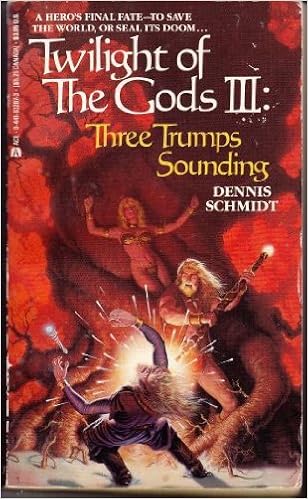
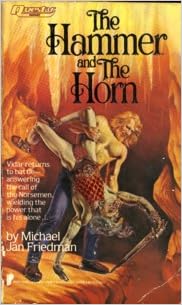
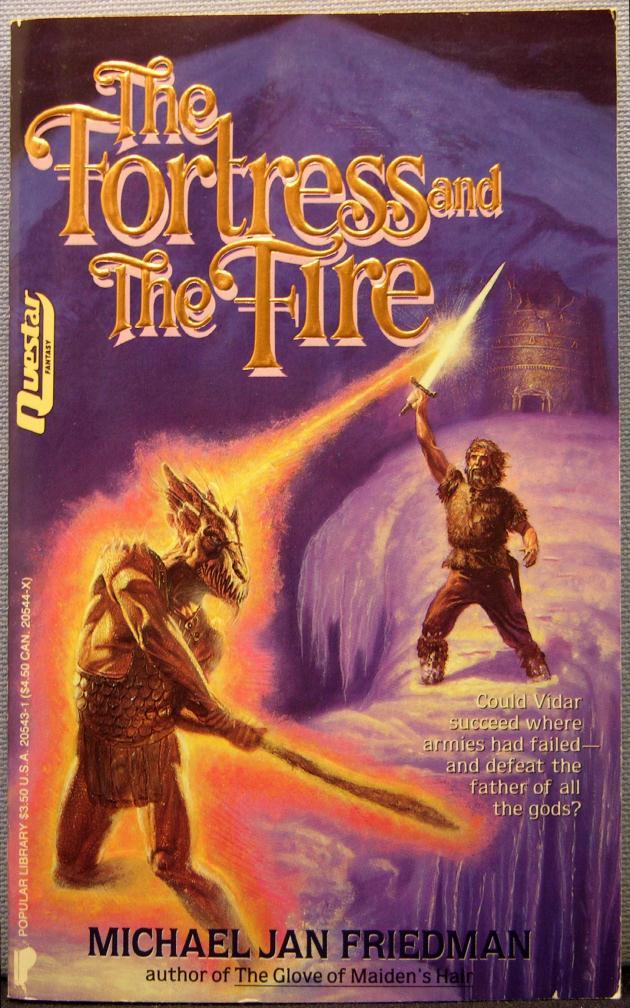
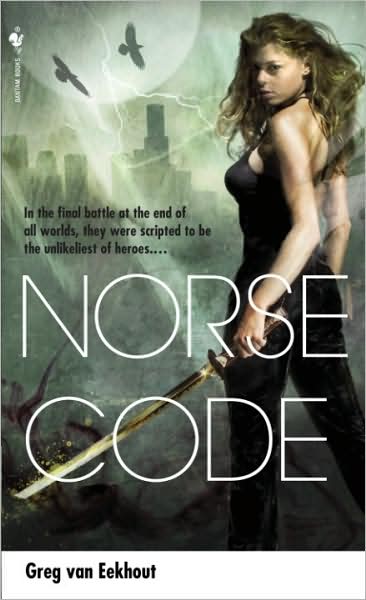
In this vein of expansive storytelling license, there's obviously Marvel's 1962 to now superhero take, but during that period Norse lore has been remixed by other daring authors, which we will survey here: Dennis Schmidt's Twilight of the Gods (1985-1987) trilogy as prequel/re-interpretive, and Michael Jan Friedman's Vidar Trilogy (1985-1988) as sequel (all pre-Neil Gaiman's American Gods [2001] & Odd and the Frost Giants [2008]), and well in advance of some conventions of Marvel and internet Rule 63 by decades. A post-Gaiman/Marvel selection also worthy of mention is Greg Van Eekout's stand-alone novel, Norse Code (2009). The first we'll review in detail, while the last two we'll briefly encapsulate.

Twilight of the Gods:


[Borr versus Surt!]
[Voden at Mimir's Well!]


[Unlike the other two, this cover art has nothing to do with the book.]


In a time of legend a la Robert E. Howard's Conan, where all ancient civilizations abide, so the Nine Norse Worlds instead get recast as other kingdoms and the world at large is itself known as Yggdrasil, the books' map going from northern Europe down to northern Africa, around an as-yet-to-be-flooded smaller Mediterranean. For example the desert dwelling Mesopotamians are the hot kingdom of Muspelheim, which makes for an interesting theory and opens one up to rethinking how strictly the stories we know & love are interpreted.

One theory about the Norse Gods is that instead they were prehistoric heroes who were then gradually euhemerized into divine beings, which is the bold step Schmidt takes with his version, but there's enough magic & supernature in his ancient world to go around.

The story starts with Borr going on an ambitious raid with Surt, and later follows Borr's son, Voden (the obvious Odin analog), on his wandering quest for knowledge, explaining along the way the stories behind his huge catalog of names, something any reader of the Eddas has been bound to wonder but never gotten an answer to. This name accruing thread is a clever & winning conceit.

Samples of interesting changes:

• Volund the Smith instead escapes from his captivity in the Jotun's northern kingdom down into Asaheim.

• The forest-dwelling Vanir are explored fully, their matriarchal society & rituals revealed. Lead by a queen Vanadis & counsel of nine Distingen priestesses, it seems their womanly superiority complex proactively causes friction with their northern plainsmen Aesir neighbors.

• Wicked deceiver Gullveig is not repeatedly speared by Aesir men and burned, but literally gang raped & thrown out, thus irreversibly "burned".

• The Mesopotamian underworld dragon Tiamat is likened to Norse Niflheim-dwelling Nidhogg, which shows how two different peoples can view what may have been ostensibly the same cosmological creature.

Schmidt is no religious studies slouch in these choices, having written an Eastern philosophy-based space opera as well, and integrates shamanic experiences, astral travel, and anthropology in his tellings. Legendary figures from other cultures also appear contemporaneously alongside Voden on his learning curve. Of note is Lao Tzu who wanders into the second book and becomes one of Voden's mentor figures. (And for you "purists" who think the Norse developed in a vacuum, think again -- they traveled the world, met Buddhists, got decorative arts & early shipbuilding from the Celts, and set up house in coastal Portugal.) And with all the dark Mesopotamian demon-summoning know-how, one questions if Schmidt had much exposure to Simon's version of The Necronomicon (1977) ... ?

Delightfully unexpected explanations for the myths we know are given, a joy of revealing the reasons behind the stories throughout all the books:
The water churned and splashed, sending a fine spray high into the air. If one crossed the ford at a certain time of day, when the sun was in the right position, a magnificent rainbow arched across the sky. ~ [p.55, on Bifrosti's Ford (the analog to Bifrost, the rainbow bridge to Asaheim.)]
There are moments where the philosophy floats on the very top of the story, but always as a pertinent aspect of world/character-building as opposed to a deep abstraction.

Included is a homage to Dune (1965) with highly detailed ritual knifefight in Jotun culture, a veiled but profound reference to William Carlos Williams' "The Red Wheelbarrow", and even a nod to the cult film Phantasm (1979)!

While The First Name & Groa's Other Eye seem more well paced with Schmidt re-visioning the murder of Ottar & the marriage of Thor, the stories seem more heavily piled on in the third book as the end approaches as though a checklist were referred to more in the last part of the author's process. One wonders if Schmidt had given himself the leisure of a fourth book whether this might've resulted in pacing those stories deserved, but this middling issue's a small one.

Schmidt's ambitious trilogy covers Voden's story from child to epic hero/magician/legend/apotheosis. At any time one wouldn't look twice at these books which appear just like any other pulp paperback gathering dust to be thrown out for new stock at a used bookstore, but we implore you that if you are a fan of Norse Mythology and fantasy in general, these long-hidden gems should be rescued and added to your library's treasure hoard.

Vidar Trilogy:


Michael Jan Friedman fearlessly remixes the Norse Lore by writing a sequel to the story long after the Eddas end. Odin's son, Vidar, survives Ragnarök and reacts to the war to end all wars by leaving the Aesir behind for a more creative & peaceful life on Midgard. We find our god of vengeance, now inconceivably old but still eternally young, making & selling sculpture as a bohemian artist in NYC. Of course, his past comes back to slowly but surely interfere with his new life.

As things unfold, we discover that Vidar spent much of his intervening lifetimes as a skald, and the narrative is interspersed with flashbacks that show the "true" versions of the great events of Norse legend he remembers from actually being there, versus the ones we got in diluted & altered form told by others, and these variants prove interesting, revealing the gods as different from the ones we know ... .

There are shades of Roger Zelazny's The Chronicles of Amber (1970–1991) in the Aesir, which adds an interfamilial complexity worth discovering.

Norse Code:


[Yes, a smart neo-valkyrie would select a katana.]
Greg van Eekhout's one-novel take on Norse lore finds our present world in strange days: political unrest, extremely weird weather, and the evident erosion of society itself. But the covert NorseCODE genome project knows better, and valkyrie Katy Castillo secretly finds & gathers the descendants of Odin for recruitment into the Aesir's final army that will hopefully save us all.

Along the way she finds wayward god Hermod, now a sort of vagrant wanderer L.A. dude who she enlists to help her go off the reservation and find out what's happened to her sister. There's a modern black humour reminiscent of wry Scandinavian sensibilities, while prophetic world doom quickly races them to the book's very rewarding end.


Unlike the lately released Rick Riordan's Magnus Chase and the Gods of Asgard or the less developed The Blackwell Pages trilogy by Armstrong & Marr, both for the lucrative young adult market, the above selections don't go for a shallow modern adolescent commentary, but celebrate & admire the original material while building soaring structures with newfound aspects on top of the Eddaic foundations.

This Norseplay shows the unshakeable constitution of these influential stories, their polyvalent nature, and the timeless endurance of the Gods.


#   #   # 


While a mostly happy bookstore fixture for over two decades, Guillermo Maytorena IV is currently willing to entertain your serious proposals for employment as a literary/cinema critic, goth journalist, castellan, airship pilot/crewperson, investigative mythologist, or assisting in a craft brewery. Should you be connected to any of the above or equally interesting endeavours, do contact him via LinkedIn or G+.

Monday, January 11, 2016

Zafóning into The Mist Trilogy.

We wanted to eschew reading any more young adult titles, but at the end of The Shadow of the Wind author Carlos Ruiz Zafón narratively fishhooks us by noting that hero character Daniel Sempere grows up and goes on to write The Prince of Mist -- which just happens to be the title of the first of Zafón's YA books. Thus we are caught by the twin barbs of curiosity & compulsion to know if these juvenile works actually have relevance to his masterful adult ones.

Yet in this baiting of our reading cues, we find that while good, Zafón's YA falls a grade just below the texture & completeness of his other The Cemetery of Forgotten Books trilogy. There's the same edgy anticipations, looming gothic structures, innocent characters threatened by past tragedies, and all the darkly delightful earmarks, but it's Zafón-lite. Still, Zaf
ón-lite is better than most other authors on their most gravitas of writing days. 


[Slightly more defined import cover figure than on the U.S. version.]

The Prince of Mist

From the author's opening note:


"I like to believe storytelling transcends age limitations, and I hope readers of my adult novels will be tempted to explore these stories of magic, mystery, and adventure."

A classic R.L. Stevenson thing to say, and entirely appropriate.

This first installment's nothing less than Bradberryesque, a childhood-that-never-was small town paene in the vein of Something Wicked This Way Comes, complete with an equivalent parallel to Mr. Dark, and as sinister a group as Darren Shan's Cirque Du Freak could muster. Like these other two, there are elements that are brutally adult, and like all great children's books, they strive to appeal to all ages so they can both awe the young with their dark wonder, and stand the weathering test of acidic maturity.

Zafón almost spares us the YA trope of orphans, but maintains one character, Roland, as having lost his parents to an accident. Beachcomber Roland befriends seaside town newcomer Max, and by association, his unignorable lovely sister Alicia, which of course makes for a strained relationship dynamic:


"Hey," Max hissed at him. "She's my sister, not a piece of cake. Okay?" [ch 6, p.65] 

As the children's summertime unfolds, weird inexplicable events begin to happen in their old house with a mysterious past, and the search for answers begins. 

When the novella progresses and we just begin to see the adversary, carnival leader Cain's powers are never really defined, and his threat becomes too powerful, and his villainous behaviour too Snidely Whiplash arch, with his motives far less clear than foreclosure or banging virginal Nell:


"In an infinite universe, there were too many things that escaped human understanding." [ch 12, p.147]

Unlike Zafón's The Angel's Game, where a loose magical realism and far more complete style frames the narrative, the above quote allows Cain a limitless supernatural might, which stretches credulity, and makes his lines feel more comic book caricature than realized literary character. 


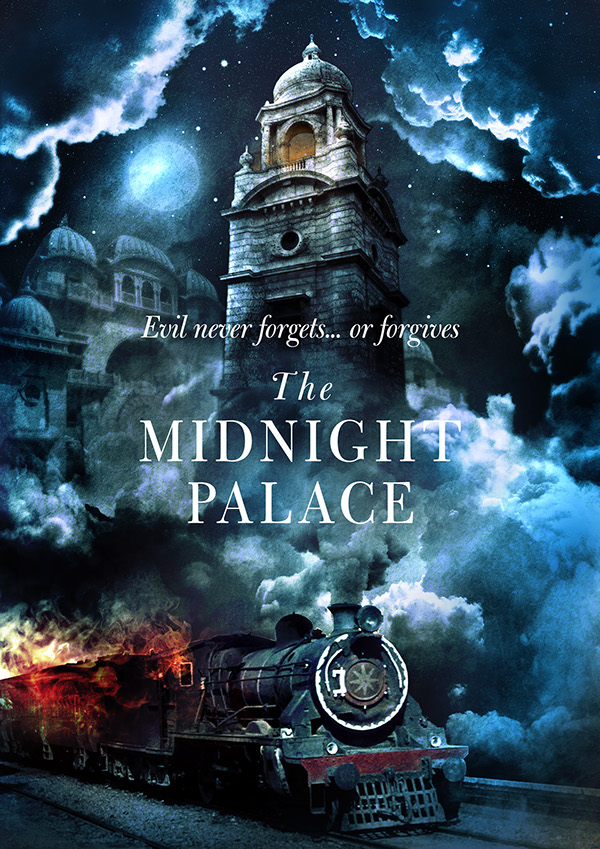
The Midnight Palace

An even more marked departure from Zafón's familiar home Barcelona, surprisingly set in a past exotic Calcutta, this middle book launches the reader into a vicious in media res beginning chase. This is an English imperial novella, but with some parallels of India pre-liberation to the author's native post-Spanish Civil War. The pacing's quickly constructed, and up & running from the get go.

Starring a cadre of precocious Indian children you so wished were your intellectually wisecracking friends, at childhood's end on the eve of their graduation from a Christian orphanage, we discover they also have in common The Chowbar Society: A secret clique mutually dedicated to aiding each other, meeting in a nearby abandoned house they've dubbed The Midnight Palace, where they sneak off to tell ghost stories, personal confessions, and problem solve. It is this altruistic society that runs up against hunter-villain Jawahal, a dark pyromancer, who, for unknown reasons, is after their new friend Sheere.

In contrast to the pacing, Zafón unfolds the mystery with tantalizing slowness, and the reader is compelled through urban Calcutta to follow these youths to a deadly and long hidden truth.

The Midnight Palace, a place plainly dilapidated with abandoned neglect by day, but is imbued with evocative magic for the teens by night, itself displays Zafón's love of architecture:


"The place exuded that aura of magic and dreams that rarely exists beyond the blurred memories of our early years." [p.79]

The celebratory ornaments of buildings easily slides into the spectrum of the sinister in many other of the book's settings, so the wonder is equally matched, and at times outdone, by the spooky.


Like Star Wars' prequel trilogy, the narrative arc becomes about the antagonist as its his slowly revealed history that frames the narrative and motivates the Chowbar Society's desperate investigations. This antagonist's similarities to the first book also place them as a shade too arch, more of a Freddy Kruger entity, nightmarish, complete with a boiler (for real). This final unveiling nearly undermines all the exotic delight and panoply of characters the book otherwise has. And in this strength alone, Zafón could easily write a series of Chowbar Society stories, the construct is so winning, but we only get this one.


The Watcher in the Shadows


Of the three, this mostly resembles his adult works, which makes sense as he wrote it last. Zafón again departs from his Catalanes setting into nearby Normandy, France.

With many similarities to Prince, we follow a family with even more unfortunate circumstances to a small coastal town where widow Simone takes a household managing post for an eccentric genius toymaker, as her children Irene & Dorian adjust to their new home nearby.

Zafón delivers yet another wonderful mansion setting full of spooky automata, but laced with pathos:


"As she listened to the toymaker’s words, Irene realised she would no longer be able to view Cravenmoore as the magnificent product of a boundless imagination, the ultimate expression of the genius that had created it. Having learned to recognise the emptiness of her own loss, she knew this place to be little more than the dark reflection of the solitude that had overwhelmed Lazarus during the past twenty years. Every piece of that marvellous world was a silent tear." [p.23]

And if you're reading Mists as we were for its connection to The Cemetery of Forgotten Books, Andreas Corelli gets mentioned in passing, and so the tie-in (two books later!) is finally revealed. Also the villain's nature more closely ties this third installment in with Mist but less so with Midnight.

As far as connections that make this a trilogy, the ability to "shadow" in the Zafóniverse results in similar adversaries in all three, and the Faustian bargaining exhibited in The Angel's Game strikes the same chord through these books. In both trilogies Zafón persistently explores the sins-of-the-father, and the quest of the innocent to both uncover & escape the horrors of generations past. The cost of doing so is always that same innocence.


[Zafón is the man!]
Not as complex, not as ornate, but one can see the formative merits as Zafón cuts his chops in this earlier material and the building of the writing to come. The comparison of earlier to later books is perhaps unfair as these are intended for a younger audience, but given the aforementioned fishhook, adults will be compelled to pick them up just to see if the later story seeds from The Mists Trilogy. Yet one can easily imagine that if Zafón had incubated these awhile longer & re-drafted, they very well might have had the same impact as his adult literature.


#     #     #

While a mostly happy bookstore fixture for over two decades, Guillermo Maytorena IV is currently willing to entertain your serious proposals for employment as a literary/cinema critic, goth journalist, castellan, airship pilot/crewperson, investigative mythologist, or assisting in a craft brewery. Should you be connected to any of the above or equally interesting endeavours, do contact him via LinkedIn or G+.

Saturday, November 28, 2015

i love parentheses,

I love parentheses

(an aside, a secret, a shining coin of color or truth gleaming under a great lake of paragraph

[a luminous shell of electrons set valent about a dark core, the gravity of words nested within

{like a fine set of earrings framing the face of a girl you haven't confessed your heart to yet.
}]).

#   #   #

While a mostly happy bookstore fixture for over two decades, Guillermo Maytorena IV is currently willing to entertain your serious proposals for employment as a literary/cinema critic, goth journalist, castellan, airship pilot/crewperson, investigative mythologist, or assisting in a craft brewery. Should you be connected to any of the above or equally interesting endeavours, do contact him.

Tuesday, November 17, 2015

Chasing Magnus through the Norse Lore.

The unwritten criticism of young adult offerings (and it's not a genre, it's a market) is that none ever seem to pass the bar of its progenitor J.K. Rowling -- all else that follows Harry Potter's been derivative. Nor have they been able to strike such a grand balance between character & world-building as Rowling.

That bar still remains unapproached by Rick Riordan's latest trilogy series launch, Magnus Chase and the Gods of Asgard: The Sword of Summer, though you'd think with the richness of Norse Lore to draw from it might surpass the young wizard, but Magnus makes for a fun read.

Much like Riordan's Percy Jackson series, our titular protagonist has a mystery daddy, is a streetwise kid, has an important prophecy at age 16 event to propel their plot, and much internal thought reactions of sophomoric adolescent "smartness" in their texts for the teen reader & young-at-heart to identify with.

And our newly chosen hero & his varied party of gifted friends must accomplish a quest by a deadline for a lost object. Since Homer, or Tolkien, however, we never tire of this story's formula.

In contemporary fantasies our modern interpolations on ancient legends are where the humour's supposed to come from. Would today's modern man appreciate Valhalla? Maybe if it were turned into a hotel is Riordan's answer. And the pop culture references are meant to give enough perspective for a young & modern audience to see Riordan's pushing forward of the long-hidden denizens of the Nine Norse Worlds, but push the results of this technique ten years on and it might read more dated than classic. 

Where Magnus really shines is when it provides other unthought of specifics & fill-ins, such as an actual descriptor of the taste of Mimir's well of knowledge, or elaborating on the current results of Freya's bartering with the dwarven Brisings, adding to the list of "paradox ingredients", or the unique physics of Jotunheim.
"The smell of the giants' body odor -- a combination of wet clay and sour meat ..." [p.388]
These new imaginings give the reader some nice mythological extras.

Another cool hard copy reader extra (because real books will always rule!) is that depending where you buy your copy, you actually get something extra: If off a pallet at CostCo, it's a bookmark. If from the shelf of Barnes & Noble, it's a small pamphlet guide to the Norse Gods. If from the bestseller rack at Target, it's a mini-poster of the Nine Worlds. And there's even a limited edition slipcased version if you order yours from Amazon UK.

Points in the plot borrow many episodes in Norse Lore but instead place Magnus & Co within them, so if you've read the original stories you'll be the inside reader:


"We met at that party at Bilskirner -- the one where you were playing tug-of-war with Loki?" 
"Oh ... ." [He] shook his horns. "Yes. That was embarrassing." [p.343]

... but not so surprised, and if you haven't read the stories the narrative will be new ... but weirdly seeming a bit forced. There's a familiar eagle dragging a character, some fishing for a large sea monster, a deception by giantesses, et cetera. Some of the comparative situations are funny, while others fall flat from trying too hard.

For Rick Riordan fans, Annabeth Chase from Percy Jackson cameos, turning out to be Magnus' cousin. This also implies a shared universe which might lead to a conflict between the pantheons ... ? Maybe even a duel between Percy & Magnus? (A Red Gold on Magnus! Sumarbrander totally breaks Riptide.)


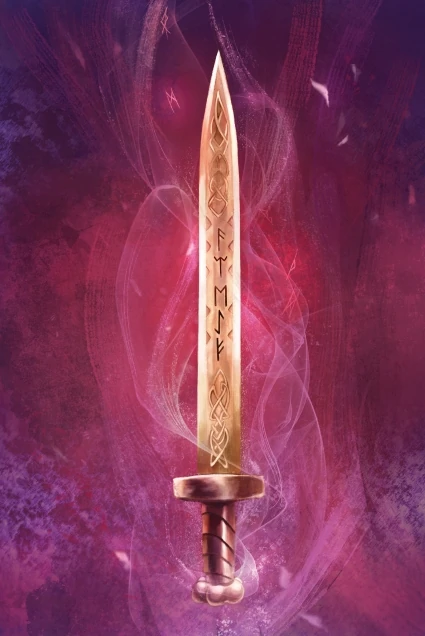
[Sumarbrander!] 
While in the Lore the monsters are universal forces of entropy & destruction, in Riordan's worlds they are external manifestations of our fears & anxieties amplified, reflections of fault & weakness & regret, giving the characters' encounters with them a more crushingly personal aspect.

And in an interesting setting decision, Texan Rick Riordan celebrates his own Boston transplantation by imbuing Beantown with a close connection to Yggdrasil, the World Tree, thus making the northeastern city a crossroads to getting from Midgard, our world, to the other Nine Worlds.

In contrast to the Lore, sometimes the book puts itself at odds with the lessons in the original stories. Odin teaches that knowledge sometimes requires levels of personal & impersonal sacrifice, but Magnus questions this and frequently whines & opines differently as he proceeds on his quest.

We would adore it if Magnus Chase were to give kids & adults new to the epic accounts of the Norse Gods the same wonder & fascination that we got from D'Aulaires' Norse Gods & Giants (which really still stands as the best [even if Magnus currently outsells it on Amazon]) when we were growing up, and enough to direct them to later go read the Eddas where they came from. In all, Riordan, previously a teacher by trade, has written an entertaining embroidery of the lore that hopefully opens this door to Asgardian narratives.

Part two of the Magnus Chase trilogy, The Hammer of Thor, is scheduled for release October 4th, 2016. We can only hold out a reader's hope that this upcoming literary Mjölnir can finally smash Potter's wand.


#  #  #

While a mostly happy bookstore fixture for over two decades, Guillermo Maytorena IV is currently willing to entertain your serious proposals for employment as a literary/cinema critic, goth journalist, castellan, airship pilot/crewperson, investigative mythologist, or assisting in a craft brewery. Should you be connected to any of the above or equally interesting endeavours, do contact him.

Monday, November 16, 2015

a note to ronda.

Ronda Rousey: All your victories, accumulated skills, experience, and inspiring story still outweigh this one setback. Whether you want the belt back or not's irrelevant. You're still the best on record, and we look forward to either more fights, or an awesome movie career, or both.


#   #   #

While a mostly happy bookstore fixture for over two decades, Guillermo Maytorena IV is currently willing to entertain your serious proposals for employment as a literary/cinema critic, goth journalist, castellan, airship pilot/crewperson, investigative mythologist, or assisting in a craft brewery. Should you be connected to any of the above or equally interesting endeavours, do contact him.

Friday, November 6, 2015

thanks for thinking about the math, Pima County citizens.

So relieved the majority (~60%) of Pima County voted down all the bond proposals. Vague language, pork belly contracts, short-term rubbish. And even if some of it managed to sound important (which it wasn't), you can't spend money you don't have on top of money you already owe. Bankrupt judgment doesn't solve bankruptcy.

#   #   #

While a mostly happy bookstore fixture for over two decades, Guillermo Maytorena IV is currently willing to entertain your serious proposals for employment as a literary/cinema critic, goth journalist, castellan, airship pilot/crewperson, investigative mythologist, or assisting in a craft brewery. Should you be connected to any of the above or equally interesting endeavours, do contact him.

Wednesday, November 4, 2015

on technological irrelevancies.

XBox or Playstation is Coke versus Pepsi ... and just as irrelevant. Don't offer me bread & circuses with your trillions. Give me a real paradigm shift. Domestic robots I can lease to my workplace so I can have more time off or program to plant food or make goat cheese while I'm away so we can get off this grocery bill food chain wage enslavement treadmill that goes to death and we can instead retire early. Flying cars with safe hive mind autopilots so we can travel, adopt grander perspectives, and free will engage more than the programmed post-cathode ray windows in our homes. Game change it already. Imagine harder, world. Put that on your to-do list.


#   #   #


While a mostly happy bookstore fixture for over two decades, Guillermo Maytorena IV is currently willing to entertain your serious proposals for employment as a literary/cinema critic, goth journalist, castellan, airship pilot/crewperson, investigative mythologist, or assisting in a craft brewery. Should you be connected to any of the above or equally interesting endeavours, do contact him via LinkedIn or in the comments below.

Tuesday, October 20, 2015

NorsePlay: ideas from the Odin Brotherhood.

When Professor Mark Mirabello published The Odin Brotherhood (1992) surely many dismissed the idea of a surviving secret society of religious Norse practitioners as an attractive fantasy, or thought the dialog in the book only an Edda-like delivery system for a revival.

Understandably any sort of unearthed esoteric knowledge revealed after hundreds of years using unconfirmable sources opens itself up to scrutiny & examination, especially by reconstructionists who've had to weed out and re-plant structures in their religion, and we leave it up for those better versed in the archaeology & attestations in Asatru lore to do so.

What can't be argued is that Mirabello serves up some interesting ideas & perspectives onto the Asatruar's table, which we will present & ourselves extrapolate on here from the 5th edition (we don't have the current 6th edition [but if the publisher wished to send us one, we'd be happy to examine & revise this survey in light of the additional 50 pages, and even comment on Jack Wolf's complimentary The Way of the Odin Brotherhood {2013}, if included]).

[Bifrost to Asgard backdrop in Richard Wagner’s "Das Rheingold", directed by Otto Schenk (1990).]
The gods are presented throughout the text with unheard of epithets & cognomen, so much like the lore in using metaphorical descriptors & narrative associations to speak about the Aesir, which makes for some new additions one could use in writing or ritual.

Unlike in the Eddas, where it's the death of only a few of the gods that are detailed during the cataclysmic Ragnarök, we get a very grim additional description of the deaths of Frigg & Iðunn: "Freya will slay several trolls before she herself is killed, Idun [sic] will be soiled and raped and murdered" (p.102). There always seemed to be the implication that frost giant Þjazi perhaps did more than hold the youth-giver for her apples, but here the brutality upon her is made explicit & final.

As per the Brotherhood's origin story, a lead tablet will communicate to a dead person if buried at their grave in the winter (p.17). It's the exception that the dead answer, and it was a reply that formed their secret society.

The OB claim there are three types of death that lead to three different afterlife realms: Death in battle, the straw death of old age/sickness, and death by sorcery. Death in battle is a requirement in order to psychologically face death again when Ragnarök comes. In stark contrast, death by magick is bad since that ending denies the final army better numbers, thus giving us a longterm applied reason to avoid using magick for fatalities in the first place, which the OB states is "killing with words" and used by "all who thrive on malice" (p.74). The need for battle death also makes a fitting justification for Odin's grand plan to prepare for Ragnarök.

"Some men become terrified and dizzy at great heights. According to an old legend, it is the proximity of the gods at great heights that makes people afraid." (p.50) This passing detail jibes with citations that meditations to seek clarifying visions took place on high places, much like Odin camping on high seat Hliðskjálf to gain the best perspective.

All the gods cast a "light shadow" more like a reflection, as opposed to our conventionally dark shadow; therefore they'll only visit Midgard at night so as to conceal themselves (p.33).

Time between Asgard & Midgard passes at different rates: "An instant in the reality of the gods is an epoch in the reality of men." (p.61) This temporal difference could account for divine superspeed, seeming multi-locatant, and the need for special apples to offset aging. If men enter the reality of the gods, aging occurs, a reversed principle similar to the fairyland tales where visiting/kidnapped mortals don't age, while time passes much faster back home.

As for other realms, the OB locates Alfheim "where every river begins": "Rain is where every river begins, so the Elf-World is somewhere in the architecture of the clouds" (p.67). 

Frost giants & fire giants "exist in oblique corridors" (p.43), implying a nearby plane or dimension where they lay in wait for those barriers to break down when the universe ends. Sort of Lovecraftian, yes?

Death is hands-on sexy:
"AUTHOR: From the Odinist perspective, what is death?

THE ODIN BROTHERHOOD: In poetic terms, death itself is personified as beautiful females who exist in an endless variety of exquisite forms. These females are called the valkyries.

AUTHOR: And these valkyries extinguish life?

THE ODIN BROTHERHOOD: Yes. The gentle hands of the valkyries softly and voluptuously do the work of killing." (p.71)
Well, if you're putting it like that, death is a welcome pornography.

Endtimes update: Baldur is already dead (p.82). As the forerunning prophecy for Ragnarök, this places a greater urgency on the current state of things as far as the OB see it.

The text also presents the idea of time as an eternal cycle, similar to science's oscillating cosmology theory where the universe big bangs out (like Niflheim's ice mixing with Muspelheim's fire to explode matter into being), then gravity stalls the expansion and draws it back to collapse onto itself, only to bang out again, but the gods return with every universal genesis, like the lore mentioning Baldur's return after the sturm und drang of the current world's end is finished and everything resets. 

As for fate, it is something that's already woven out for us (p.93): "We cannot choose the joys or the terrors we must face, but we can choose to face them calmly. That is our freedom." Ergo, the inevitable's going to happen, but how we deal with it makes the difference.

And finally, the OB claims that when honor & heroic action are no longer found on Midgard, the separate worlds will break down, and Ragnarök will happen. So in the very act of honouring the old gods, we stave off Ragnarök indefinitely, and that alone is reason enough to venerate the Aesir. It's in our interest & the gods' interest to blot, for these interests of preservation, celebration, and recognition are one in the same.

Whether one buys the Eddaic adornments of what the OB's secret lore says or not, they provoke us to rethink what we know, and their last and most important point reminds us that in honoring the gods, we also honor the potential for our best selves and the world around us, all in the same horn, and that alone is worth listening (and drinking) to. 


#   #   #

While a mostly happy bookstore fixture for over two decades, Guillermo Maytorena IV is currently willing to entertain your serious proposals for employment as a literary/cinema critic, goth journalist, castellan, airship pilot/crewperson, investigative mythologist, or assisting in a craft brewery. Should you be connected to any of the above or equally interesting endeavours, do contact him via LinkedIn or G+